
Mathematics
The base of an isosceles triangle is 16 cm and its area is 48 cm2. The perimeter of the triangle is :
24 cm
30 cm
36 cm
42 cm
Mensuration
1 Like
Answer
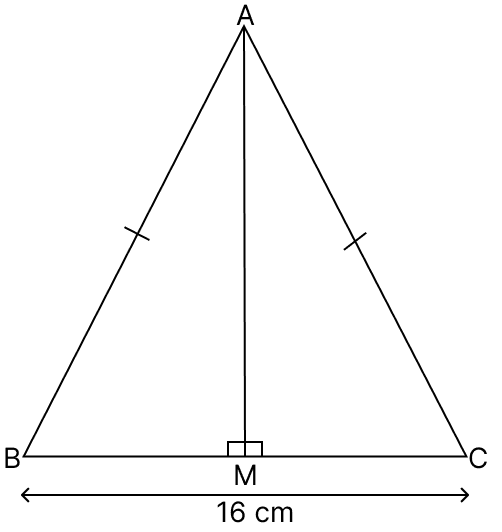
From figure,
ABC is an isosceles triangle with AM as the height and BC as the base.
Base (BC) = 16 cm
Area of triangle = × base × height
⇒ 48 = × 16 × AM
⇒ 48 = 8 × AM
⇒ AM = = 6 cm.
In an isosceles triangle,
The altitude from the common vertex bisects the base.
In triangle ABC,
The altitude AM bisects the base BC.
So, BM = MC = = 8 cm.
Using Pythagoras theorem for the △AMB,
Hypotenuse2 = Base2 + Height2
⇒ AB2 = BM2 + AM2
⇒ AB2 = 82 + 62
⇒ AB2 = 64 + 36
⇒ AB2 = 100
⇒ AB = = 10 cm.
∴ AC = AB = 10 cm.
Perimeter of triangle = Sum of all sides of the triangle
= AB + AC + BC
= 10 + 10 + 16 = 36 cm.
Hence, option 3 is the correct option.
Answered By
2 Likes
Related Questions
The area of a rectangle is thrice that of a square. Length of the rectangle is 40 cm and the breadth of the rectangle is times that of the side of the square. The side of the square is:
15 cm
18 cm
20 cm
24 cm
A field is in the shape of parallelogram, whose adjacent sides are 120 m and 170 m. If its one diagonal is 250 m, then cost of ploughing the field at ₹20 per sq m is :
₹ 90,000
₹ 1,20,000
₹ 1,80,000
₹ 3,60,000
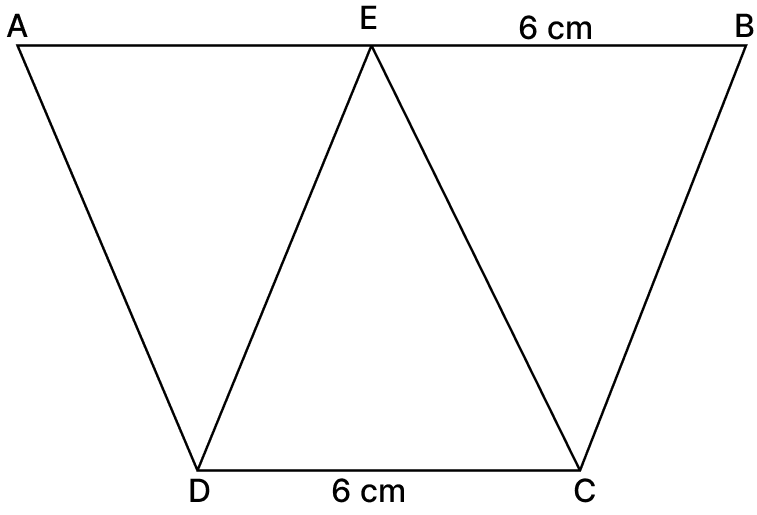
In the given figure, ABCD is a trapezium in which AB || CD. If area of △BEC is 12 cm2, then area of △EDC is :
12 cm2
6 cm2
24 cm2
none of these
A student wrote the Heron's Formula in his notebook as below.
Area of a triangle with sides a, b and c
= .
Is it correct?