
Mathematics
If bisectors of ∠A and ∠B of a parallelogram ABCD intersect each other at P, of ∠B and ∠C at Q, of ∠C and ∠D at R and of ∠D and ∠A at S, then PQRS is a :
rectangle
rhombus
parallelogram
quadrilateral whose opposite angles are supplementary
Rectilinear Figures
1 Like
Answer
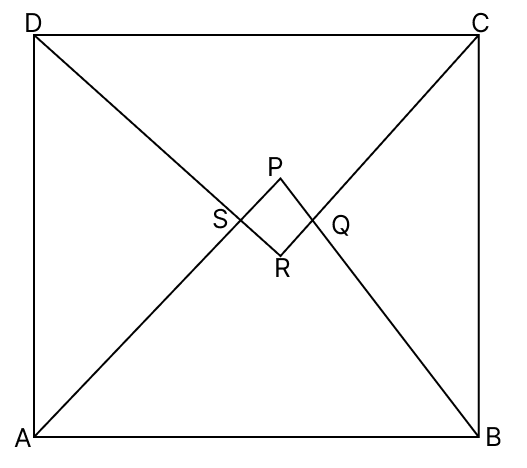
∠A + ∠D = 180° [sum of Co-Int. angles in ∥gm is 180°]
⇒ = 90°
In triangle ASD,
∠DAS + ∠SDA + ∠ASD = 180°
+ ∠ASD = 180°
90° + ∠ASD = 180°
∠ASD = 90°
∠PSR = ∠ASD = 90° [Vertically opposite angles]
∠S = 90°
∠B + ∠C = 180° [sum of Co-Int. angles in ∥gm is 180°]
⇒ = 90°
In triangle BQC,
∠QCB + ∠QBC + ∠CQB = 180°
+ ∠CQB = 180°
90° + ∠CQB = 180°
∠CQB = 90°
∠PQR = ∠CQB = 90° [Vertically opposite angles]
∠Q = 90°
∠A + ∠B = 180° [sum of Co-Int. angles in ∥gm is 180°]
⇒ = 90°
In triangle APB,
+ ∠APB = 180°
90° + ∠APB = 180°
∠APB = 90°
∠P = 90°
In quadrilateral PQRS,
By angle sum property of quadrilateral:
∠P + ∠Q + ∠R + ∠S = 360°
90° + 90° + ∠R + 90° = 360°
∠R + 270° = 360°
∠R = 360° - 270°
∠R = 90°
Since, all angles of PQRS = 90°
∴ PQRS is a rectangle
Hence, option 1 is the correct option.
Answered By
2 Likes
Related Questions
Assertion (A) : If diagonals of a quadrilateral are equal, then it must be a rectangle.
Reason (R) : The diagonals of a rectangle are equal.
A is true, R is false
A is false, R is true
Both A and R are true
Both A and R are false
Assertion (A) : Every square is a parallelogram.
Reason (R) : In a square as well as in a parallelogram, the diagonals are equal in length.
A is true, R is false
A is false, R is true
Both A and R are true
Both A and R are false
Diagonals of a quadrilateral ABCD bisect each other. If ∠A = 35°, then ∠B is equal to :
145°
135°
155°
35°
ABCD is a trapezium and P and Q are the mid-points of the diagonals of AC and BD. Then PQ is equal to :
AB
CD
(AB − CD)
(AB + CD)