
Physics
A block and tackle has two pulleys in each block with the tackle tied to the hook of the lower block and the effort being applied upwards.
(a) Draw a neat diagram to show this arrangement and calculate its mechanical advantage.
(b) If the load moves up by a distance x, by what distance will the free end of the string move up?
Machines
11 Likes
Answer
(a) The arrangement is shown in the figure given below :
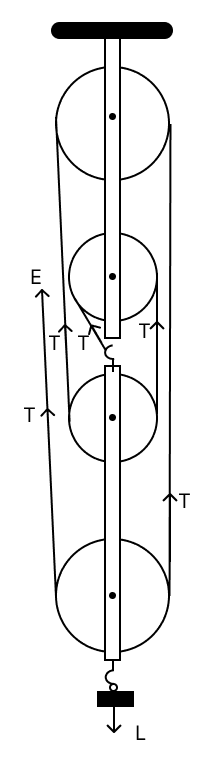
Here, the load is being supported by five segments of the string.
∴ L = 5T and E = T
Then,
M.A. =
= = 5
∴ Mechanical advantage of the system is 5.
(b) In an ideal block and tackle system, if n segments of rope support the load, then the total length of the rope pulled = n × x.
As, here the load is being supported by five segments of the string then if the load moves up a distance x,
then,
Free end of the string will move up by a distance = 5x
Answered By
7 Likes
Related Questions
State whether work is done or not by writing yes or no, in the following cases?
(a) A man pushes a wall.
(b) A coolie stands with a box on his head for 15 min.
(c) A boy climbs up 20 stairs.
The diagram given below shows a ski jump. A skier weighing 60kgf stands at A at the top of ski jump. He moves from A and takes off for his jump at B.
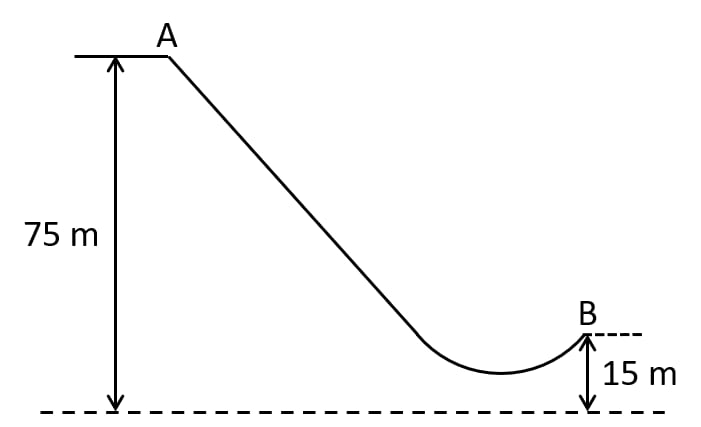
(a) Calculate the change in the gravitational potential energy of the skier between A and B.
(b) If 75% of the energy in part (a) becomes the kinetic energy at B, calculate the speed at which the skier arrives at B.
(Take g = 10 ms-2).
(c) Does total mechanical energy change during the ski jump?
A person standing between two vertical cliffs and 640 m away from the nearest cliff produces a sound. He hears the first echo after 4 s and the second echo 3 s later. Calculate :
(a) The speed of sound in air and
(b) The distance between the cliffs
Two pendulums C and D are suspended from a wire as shown in the given figure. Pendulum C is made to oscillate by displacing it from it's mean position. It is seen that D also starts oscillating.
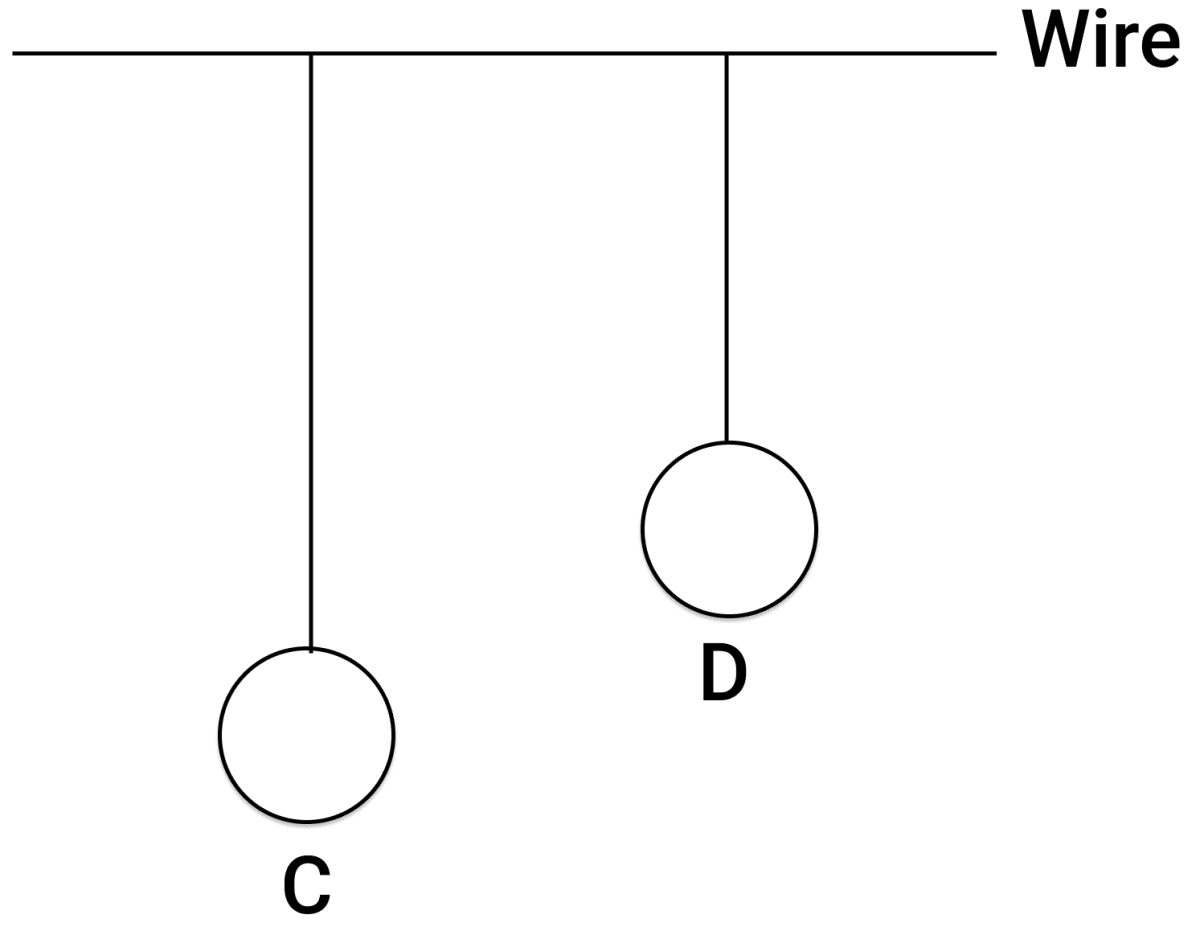
(i) Name the type of oscillation, C will execute.
(ii) Name the type of oscillation, D will execute.
(iii) If the length of D is made equal to C, then what difference will you notice in the oscillations of D?
(iv) What is the name of the phenomenon when the length of D is made equal to C?