
Physics
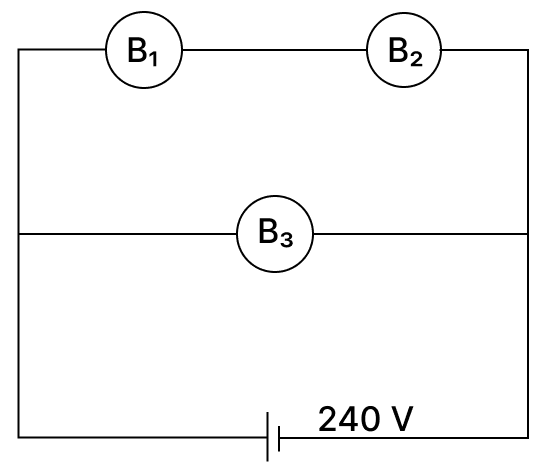
A bulb B1 100 W, bulb B2 60 W and bulb B3 40 W are connected as shown in the figure. The output powers of these would be :
- W1 < W2 < W3
- W1 = W2 > W3
- W1 > W2 > W3
- W1 > W2 = W3
Current Electricity
1 Like
Answer
W1 < W2 < W3
Reason — The bulbs B1 and B2 are connected in series in the upper branch, while bulb B3 is connected in a parallel branch directly across the 240 V supply.
For bulbs of the same voltage rating,
So, resistance is inversely proportional to power.
Thus,
- 100 W bulb has the least resistance
- 60 W bulb has greater resistance
- 40 W bulb has the greatest resistance
Hence,
R1 < R2 < R3
Since B1 and B2 are in series, the same current flows through both. Power in a series circuit is given by:
P=I2R
Therefore, the bulb with greater resistance in that branch will consume more power.
So,
W2 > W1
Bulb B3 is connected directly across the mains, so it gets the full 240 V and works at its rated power, i.e. 40 W.
But B1 and B2, being in series, share the voltage, so each consumes less power than B3.
Therefore, the output powers are in the order : W1 < W2 < W3.
Answered By
1 Like
Related Questions
A bulb is rated 100 W-220 V. It is being used at 110 V supply. The power consumed by bulb is:
- 100 W
- half of 100 W
- nearly 25 W
- none of the above
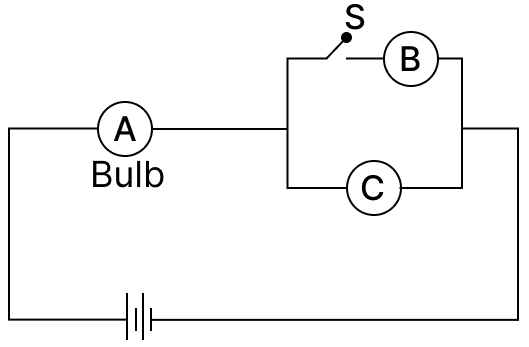
Three bulbs A, B and C are connected as shown in the figure. What changes are seen in brightness of the bulbs if switch S is closed?
- The brightness of bulb A decreases and that of C increases.
- The brightness of bulb A increases but that of C decreases.
- The brightness of both bulbs A and C decreases.
- The brightness of both bulbs A and C remains the same.
Assertion (A): In series combination of electric bulbs, the bulb of lower power emits more light than that of the higher power.
Reason (R): The lower power bulb in series gets more current than the higher power bulb
- both A and R are true and R is the correct explanation of A
- both A and R are true and R is not the correct explanation of A
- assertion is false but reason is true
- assertion is true but reason is false
Assertion (A): In parallel combination of electrical appliances, total power consumption is equal to the sum of the power of individual appliances.
Reason (R): In parallel combination, the voltage across each appliance is the same.
- both A and R are true and R is the correct explanation of A
- both A and R are true and R is not the correct explanation of A
- assertion is false but reason is true
- assertion is true but reason is false