Mathematics
Case Study: There is a circular park in a colony. The diameter of the park is 40 m. Three poles A, B and C have been eracted at equal distances on the boundary of the park. These poles have been connected with each other using straight wires, as shown in the figure. Based on this information, answer the following questions: 1\. The circumference of the circular park is : (a) 125.6 m (b) 130 m (c) 251.2 m (d) 257.2 m 2\. A child cycles along the boundary of the park in clockwise direction. The distance covered by the child in going from B to C is : (a) 41.8 m (b) 83.7 m (c) 20.9 m (d) 125.6 m 3\. ABC is : (a) a scalene triangle (b) a right triangle (c) an equilateral triangle (d) an isosceles triangle 4\. If we draw perpendicular from B on AC, then it will pass through : (a) centre of the circle (b) circumcentre of the circle (c) centroid of the circle (d) all the above 5\. The length of the piece of wire used to connect any two poles is : (a) 20 m (b) 20 m (c) 20 m (d) 60 m
Related Questions
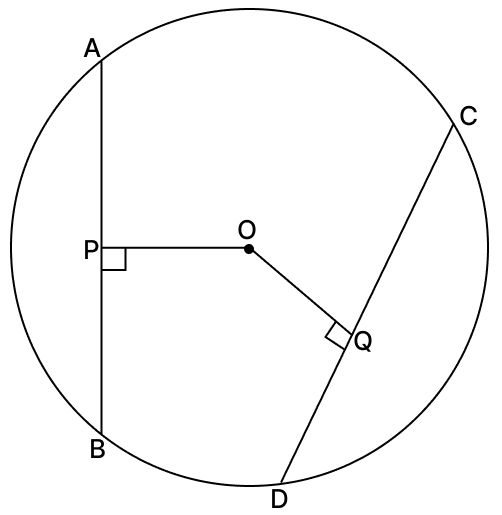
In the figure, O is the centre of the circle and OP = OQ and CD = 6 cm. The length of AB is :
6 cm
12 cm
3 cm
5 cm
A chord of length 70 cm is drawn in a circle of radius 37 cm. The distance of the chord from the centre of the circle is :
20 cm
15 cm
14 cm
12 cm
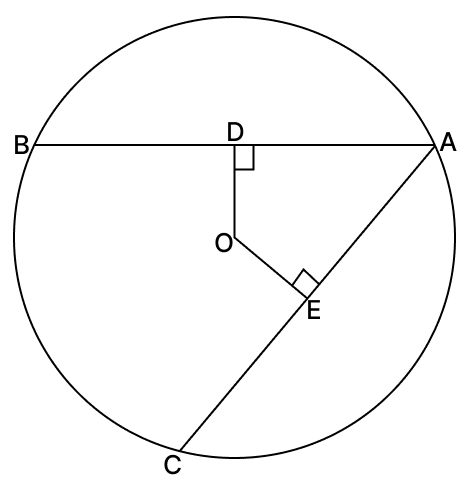
Assertion (A): In the figure, AB and AC are equal chords of a circle with centre O. If OD = 4 cm, then OE is also 4 cm.
Reason (R): Equal chords of a circle are equidistant from the centre.
A is true, R is false
A is false, R is true
Both A and R are true
Both A and R are false
Assertion (A): Longer is the chord, longer is its distance from the centre.
Reason (R): Chords of a circle that are equidistant from the centre of the circle are parallel to each other.
A is true, R is false
A is false, R is true
Both A and R are true
Both A and R are false