Biology
Choose the odd term out from each of the following set of terms. Mention the category to which the remaining three belong:
(a) Sulphur dioxide, Oxygen, Carbon monoxide, Nitrogen dioxide.
(b) Pons, Epidermis, Xylem, Phloem.
(c) Tympanum, Pinna, Auditory canal, Malleus.
(d) Ureter, Urethra, Uterus, Renal Pelvis.
(e) Stomata, Lenticles, Cuticle, Root hair.
Pollution
35 Likes
Answer
(a) Odd term — Oxygen
Category of the remaining terms — Air Pollutants.
(b) Odd term — Pons
Category of the remaining terms — Plant tissues.
(c) Odd term — Malleus
Category of the remaining terms — Parts of outer ear.
(d) Odd term — Uterus
Category of the remaining terms — Parts of Excretory system.
(e) Odd term — Root hairs
Category of remaining terms — Structures involved in transpiration in plants.
Answered By
19 Likes
Related Questions
Give the biological/technical terms for the following:
(a) A mixture of smoke and fog.
(b) The inner lining of uterus.
(c) The pressure that is responsible for the movement of water molecules across the cortical cells of the root.
(d) The ground substance present in a chloroplast.
(e) The fluid present between the layers of meninges.
Given below is the diagram of a human heart. Read the information below the diagram and fill in the blanks:

The human heart pumps blood throughout the body. It is the size of a large fist. The heart is located between the lungs in the thoracic cavity. It has four chambers. The heart functions all through the lifespan of a person and is responsible for the survival of the person.
The heart is enclosed by a membrane called (a) …………… (Pericardium / Pleura). The ventricles give rise to two large blood vessels called (b) …………… (Pulmonary vein / Pulmonary artery) and (c) …………… (Aorta / Venacava). The flaps of the cuspid valves are kept in position by (d) …………… (Chordae tendinae / Endometrium). (e) …………… (Hepatic / Coronary) arteries supply oxygenated blood to the walls of the heart.
Rajeev, a 10 year old boy, went to an Ophthalmologist to get his eyes tested. He noticed a poster in the clinic with questions related to the parts of human eye. Help Rajeev answer the questions:
(a) Which is the fluid that lubricates the eye?
(b) Which cells help in colour vision?
(c) Which nerve sends impulses from the eyeball to the brain?
(d) Name the structure that gives colour to the eyes.
(e) Name the part that allows entry of light rays into the eye.
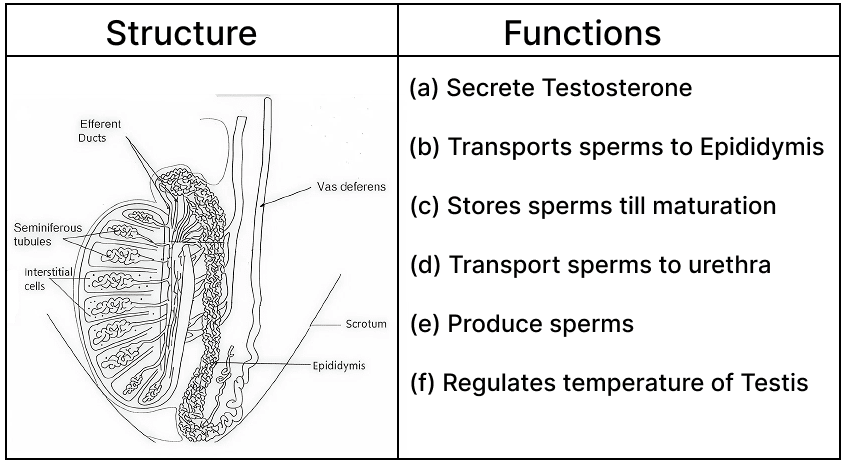
Study the diagram given below and match the structure with its function: