History & Civics
Choose the options that DO NOT apply to the immediate objectives of the Indian National Congress.
P : To prevent national workers from all parts of India from becoming personally known to each other.
Q : To end all racial, religious, and provincial prejudices to promote national unity.
R : To formulate popular demands on vital Indian problems and their presentation before the government.
S : To manipulate the public opinion.
- P and Q
- Q and R
- P and S
- R and S
Answer
P and S
Reason — The Congress aimed to promote friendly relations between nationalist political workers from different parts of the country and to train and organise the public opinion of the country. Keeping national workers unknown to each other and manipulating public opinion were never its objectives.
Related Questions
Read the two statements given below about the Partition of Bengal and select the option that shows the correct relationship between (A) and (B).
(A) The partition of Bengal was a mere readjustment of administrative boundaries.
(B) The nationalists believed that the Government did not intend to strike at the roots of Indian nationalism.
- (B) contradicts (A).
- (B) is the reason for (A).
- (A) is true, but (B) is false.
- (A) and (B) are independent of each other.
Analysing the picture given below, identify the statement that does NOT align with its content.
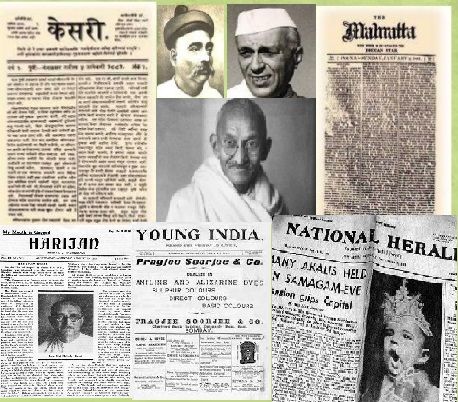
- The press spread modern liberal ideals such as liberty, freedom, and equality among the populace.
- The press provided a platform for various social groups from different regions of the country to exchange their views.
- The press played an important role in organising political movements.
- The press regularly praised the policies of the British Government in India.
Assertion (A): Gandhiji called off the Non-Cooperation Movement in 1922.
Reason (R): An unruly crowd burnt down a police station at Chauri-Chaura in 1922.
- Both A and R are true, and R is the correct explanation of A.
- Both A and R are true, but R is not the correct explanation of A.
- A is true, but R is false.
- A is false, but R is true.
The issue on which the Civil Disobedience Movement of 1930 was launched was
- equal employment opportunities for Indians
- the proposed execution of Bhagat Singh.
- salt monopoly exercised by the British Government.
- complete freedom.