
Mathematics
In a class there are 27 students. Out of these 14 study Psychology and 19 study Geography. There are 11 students who study both Psychology and Geography.
(1) How many students study Psychology but not Geography ?
- 3
- 4
- 5
- 6
(2) How many students study Geography but not Psychology ?
- 7
- 8
- 9
- 11
(3) How many students study neither Psychology nor Geography ?
- 8
- 7
- 6
- 5
(4) What is the difference between the number of students who study Psychology only and those who study Geography only ?
- 4
- 5
- 6
- 7
Sets
1 Like
Answer
Given:
Total students: n(U) = 27
Students studying Psychology: n(P) = 14
Students studying Geography: n(G) = 19
Students studying both: n(P ∩ G) = 11
(1) This represents the number of students who study Psychology only.
We use the formula:
n(P - G) = n(P) - n(P ∩ G)
Substituting the values in above, we get:
n(P - G) = 14 - 11
n(P - G) = 3
Number of students who study Psychology but not Geography = 3.
Hence, option 1 is the correct option.
(2) This represents the number of students who study Geography only.
We use the formula:
n(G - P) = n(G) - n(P ∩ G)
Substituting the values in above, we get:
n(G - P) = 19 - 11
n(G - P) = 8
Number of students who study Geography but not Psychology = 8.
Hence, option 2 is the correct option.
(3) First, find the total students who study at least one subject (n(P ∪ G)):
n(P ∪ G) = n(P) + n(G) - n(P ∩ G)
Substituting the values in above, we get:
n(P ∪ G) = 14 + 19 - 11
n(P ∪ G) = 33 - 11
n(P ∪ G) = 22
So, 22 students study either of two subjects.
To find students who study neither Psychology nor Geography, we use formula:
Students who study neither Psychology nor Geography = Total students - Students who study either of two subjects
Students who study neither Psychology nor Geography = 27 - 22
Students who study neither Psychology nor Geography = 5
Hence, option 4 is the correct option.
(4) Difference between the number of students who study Psychology only and those who study Geography only = ?
Number of students who study Psychology only = 3.
Number of students who study Geography only = 8.
Difference = 8 - 3 = 5
Difference between the number of students who study Psychology only and those who study Geography only = 5.
Hence, option 2 is the correct option.
Answered By
2 Likes
Related Questions
Write true (T) or false (F):
(i) The number of proper subsets of a set containing n elements is 2n.
(ii) Any set A and its complement are equivalent sets.
(iii) The complement of a set is a subset of U.
(iv) If n(A ∩ B) = Φ, then n(B - A) = n(B)
(v) If two sets A and B are disjoint, then n(A ∪ B) = n(A) + n(B)
Sid is given a few sets. These are represented as A, B, C, D, E, F and G on a plain sheet of paper as a Venn Diagram.
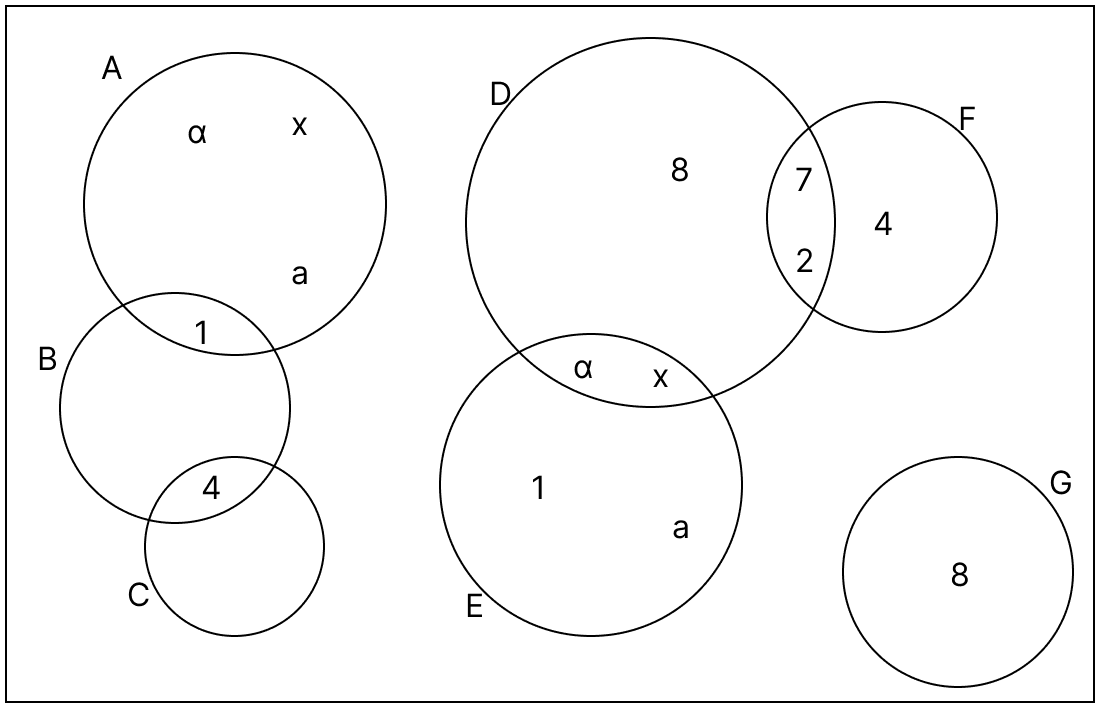
(1) How many empty sets are there in the given Venn Diagram ?
- 3
- 2
- 1
- 0
(2) How many singleton sets are there in the given Venn Diagram ?
- 0
- 1
- 2
- 3
(3) How many pairs of equivalent sets are there in the given Venn Diagram ?
- 1
- 2
- 3
- 4
(4) How many pairs of equal sets are there in the given Venn Diagram ?
- 0
- 1
- 2
- 3
Assertion: The collection of all tall girls of your class is not a set.
Reason: A well defined collection of objects is called a set.
- Both Assertion (A) and Reason (R) are true and Reason (R) is the correct explanation of Assertion (A).
- Both Assertion (A) and Reason (R) are true but Reason (R) is not the correct explanation of Assertion (A).
- Assertion (A) is true but Reason (R) is false.
- Assertion (A) is false but Reason (R) is true.
Assertion: Let P = {x : x is a factor of 24} and Q = {x : x is a factor of 30}.
P ∩ Q = {1, 2, 3, 6}.Reason: The intersection of two sets A and B is the set of all those elements of A which are not in B.
- Both Assertion (A) and Reason (R) are true and Reason (R) is the correct explanation of Assertion (A).
- Both Assertion (A) and Reason (R) are true but Reason (R) is not the correct explanation of Assertion (A).
- Assertion (A) is true but Reason (R) is false.
- Assertion (A) is false but Reason (R) is true.