
Mathematics
Construct a ΔABC in which BC = 5.3 cm, CA = 4.8 cm and AB = 4 cm. Find by construction a point P which is equidistant from BC and AB and also equidistant from B and C.
Locus
1 Like
Answer
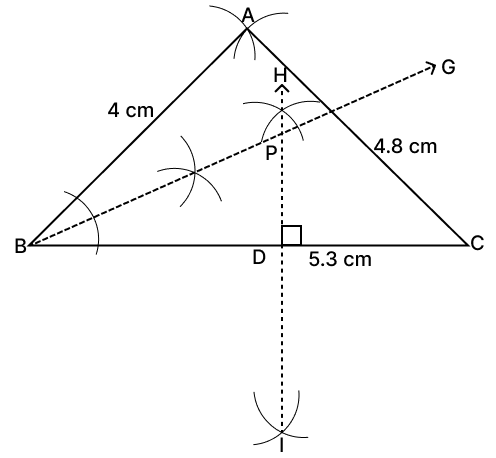
Steps of construction:
Draw base BC of length 5.3 cm.
With B as the center and a radius of 4 cm, draw an arc.
With C as the center and a radius of 4.8 cm, draw a second arc intersecting previous arc at A. Join ABC to get required triangle.
Draw BG angle bisector of ∠ABC.
Draw HI, the perpendicular bisector of BC.
The intersection of the angle bisector BG and the perpendicular bisector HI is the required point P.
Answered By
1 Like
Related Questions
Describe and construct each of the following loci:
(i) The locus of the tip of a minute hand of a watch.
(ii) The locus of the tip of the pendulum of a clock.
(iii) The locus of a point 5 cm from a fixed point O.
(iv) The locus of a point at a distance of 3 cm from a fixed line AB.
(v) The locus of a point equidistant from the arms OA and OB of ∠AOB.
(vi) The locus of the centres of all circles, each of radius 1 cm and touching externally a fixed circle with centre O and radius 3 cm.
(vii) The locus of the centres of all circles to which both the arms of an angle ∠AOB are tangents.
(viii) The locus of a point 1 cm from the circumference of a fixed circle towards the centre O, whose radius is 3 cm.
(ix) The locus of a point 1 cm from the centre of a circle of radius 2.5 cm.
(x) The locus of a stone dropped from a tower.
(xi) AB is a fixed line. State the locus of a point P such that ∠APB = 90°.
Describe the locus of a point in a rhombus ABCD which is equidistant from
(i) AB and AD
(ii) A and C
Construct ∠AOB = 60°. Mark a point P equidistant from OA and OB such that its distance from another given line CD is 3 cm.
ABC is an equilateral triangle of side 3.2 cm. Find the points on AB and AB produced which are 2 cm from BC.