Mathematics
From a cube of edge 14 cm, a cone of maximum size is carved out. Find the volume of the cone and of the remaining material, each correct to one place of decimal.
Mensuration
2 Likes
Answer
Edge of a cube = 14 cm
Volume = side3 = 143 = 2744 cm3.
Cone of maximum size is carved out as shown in figure,
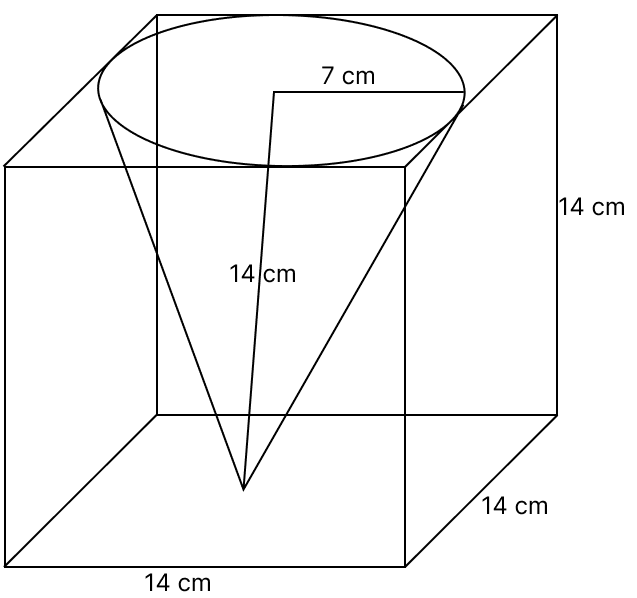
Diameter of the cone cut out from it = 14 cm
Radius, r = = 7 cm
Height, h = 14 cm
Volume of cone = πr2h
Rounding off to one decimal place = 718.8 cm3
Volume of the remaining material = Volume of the cube - Volume of the cone
= 2744 - 718.67
= 2025.33 cm3
Rounding off to one decimal place = 2025.3 cm3
Hence, the volume of the cone is 718.8 cm3 and of the remaining material is 2025.3 cm3.
Answered By
1 Like
Related Questions
A hollow metallic cylindrical tube has an internal radius of 3 cm and height 21 cm. The thickness of the metal is 0.5 cm. The tube is melted and cast into a right circular cone of height 7 cm. Find the radius of the cone, correct to one decimal place.
From a circular cylinder of diameter 10 cm and height 12 cm, a conical cavity of the same base radius and of the same height is hollowed out. Find the volume and the whole surface of the remaining solid. Leave the answer in π
A cone of maximum volume is carved out of a block of wood of size 20 cm × 10 cm × 10 cm. Find the volume of the cone carved out, correct to one decimal place.
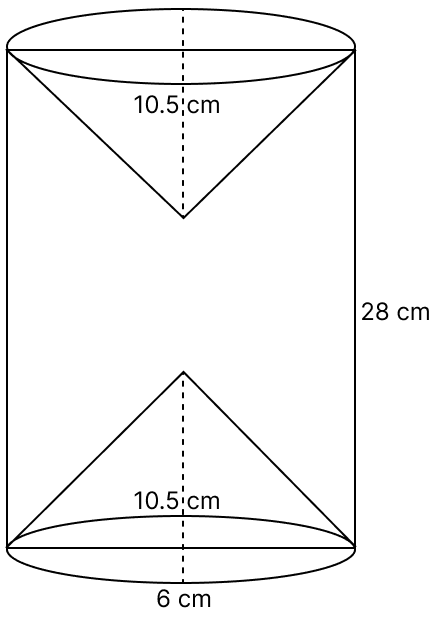
From a solid wooden cylinder of height 28 cm and diameter 6 cm, two conical cavities are hollowed out. The diameters of the cones are also of 6 cm and height 10.5 cm. Find the volume of the remaining solid.