
Mathematics
D and E are the mid-points of the sides AB and AC respectively of △ABC. DE is produced to F. To show that CF is equal and parallel to DA, we need an additional information, which is :
DE = EF
AE = EF
∠DAE = ∠EFC
∠ADE = ∠ECF
Mid-point Theorem
2 Likes
Answer
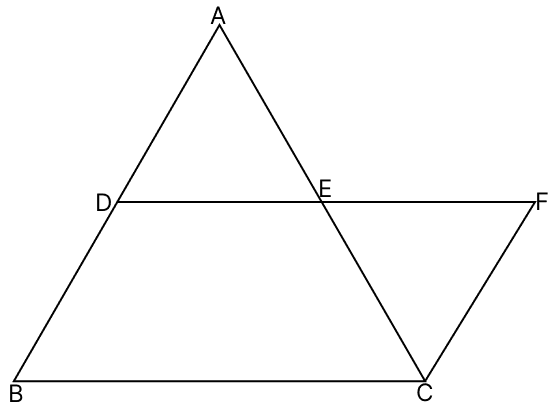
Assume that, DE = EF
In △ADE and △CFE,
⇒ AE = CE
⇒ DE = EF
⇒ ∠AED = ∠CEF (Vertically opposite angles are equal)
∴ △ADE ≅ △CFE (S.A.S. axiom)
⇒ DA = CF (Corresponding parts of congruent triangles are equal)
⇒ ∠DAE = ∠ECF ..(1) (Corresponding parts of congruent triangles are equal)
⇒ ∠ADE = ∠EFC ..(2) (Corresponding parts of congruent triangles are equal)
Since, ∠DAE and ∠ECF are alternate angles and since they are equal, thus DA // CF.
Thus, if DE = EF then DA is equal and parallel to CF.
Hence, option 1 is the correct option.
Answered By
3 Likes
Related Questions
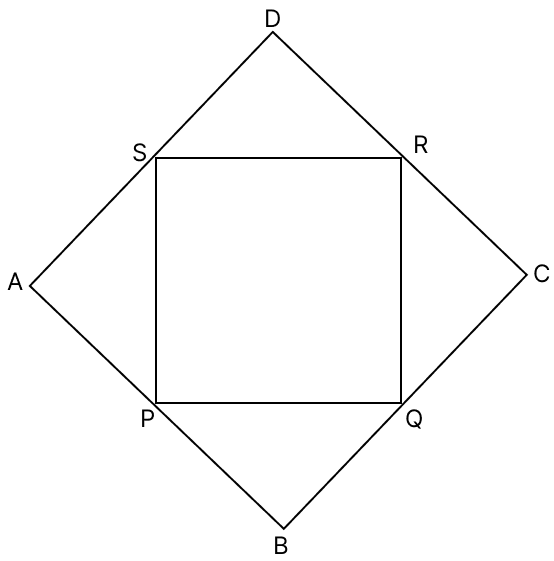
Assertion (A): The mid-points of the sides of a quadrilateral ABCD are joined in order to get quadrilateral PQRS. PQRS is a rhombus.
Reason (R): Adjacent sides of a rhombus are equal and perpendicular to each other.
A is true, R is false
A is false, R is true
Both A and R are true
Both A and R are false
The figure formed by joining the mid-points of the sides of a quadrilateral ABCD, taken in order is a square only, if :
ABCD is a rhombus
Diagonals of ABCD are equal
Diagonals of ABCD are equal and perpendicular
Diagonals of ABCD are perpendicular
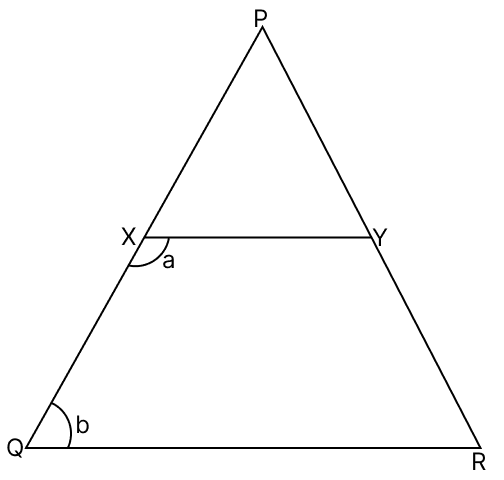
In which of the following cases you will get 2XY = QR for the given figure?
(i) When PX = QX and PY = RY
(ii) When PX = QX and a + b = 180°
Only in case (i)
Only in case (ii)
In both the cases
None of these
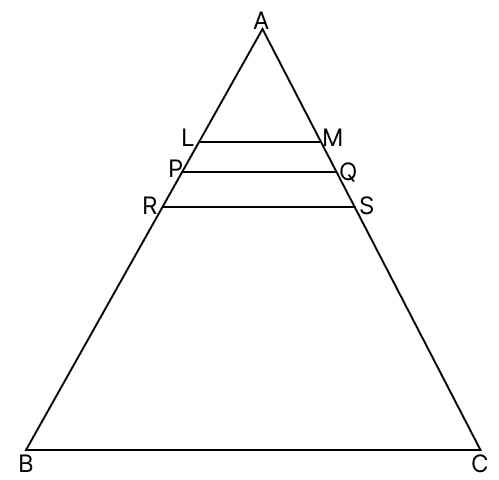
In the figure, R is the mid-point of AB, P is the mid-point of AR and L is the mid-point of AP. If RS, PQ and LM are parallel to each other, then the length of BC is :
3 LM
4 LM
6 LM
8 LM