
Chemistry
Define the term – double decomposition – neutralization reaction with a suitable representation.
Convert :
(a) an insoluble base (b) a soluble base
to their respective soluble salts by neutralization reaction.
Chemical Reaction
92 Likes
Answer
Reaction between a base and an acid to give two new compounds — salt & water — by interchange of radicals is termed double decomposition neutralization reaction.
It is represented as :
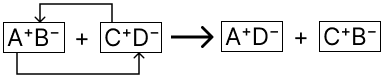
For example,
NaOH [Base] + HCl [Acid] ⟶ NaCl [Salt] + H2O [Water]
(a) Insoluble base [oxide] — Copper [II] oxide reacts with sulphuric acid and forms Copper sulphate :
CuO + H2SO4 ⟶ CuSO4 + H2O
(b) A soluble base — Sodium hydroxide reacts with HCl and forms soluble salt (sodium chloride) and water:
NaOH + HCl ⟶ NaCl + H2O
Answered By
60 Likes
Related Questions
Explain the term double decomposition precipitation reaction. Give a balanced equation for the preparation of two different insoluble lead salts from their salt solutions by double decomposition precipitation.
With the help of balanced equations - show how precipitation reactions are used for identifying the positive radicals in three different salts, each having a different cation [positive ion].
Explain the term energy changes in a chemical change. Give an example with a balanced equation, for each of the following reactions:
(a) exothermic reaction
(b) endothermic reaction
(c) photochemical reaction
(d) electrochemical reaction.
Choose the reaction which is not a chemical change under prevalent condition.
- Fe + CuSO4 ⟶
- FeCO3
- Fe
- Fe + S