Biology
Answer
The function of Ribs and Diaphragm is to aid respiration:
- Ribs — In breathing during inhalation, the Ribs move upwards and outward. This function increases the volume of chest cavity. As a result lungs expand and atmospheric air rushes into the lungs. During Exhalation, the Ribs move downwards and inward. This function decreases the volume of chest cavity as a result lungs contract and air rushes out of the lungs.
- Diaphragm — The diaphragm helps in breathing by changing its shape. During inhalation, it contracts and flattens, allowing the lungs to expand. During exhalation, it relaxes and becomes dome-shaped, helping push air out of the lungs.
Related Questions
What do you understand by the term respiratory diseases? Name any three common respiratory diseases.
State the cause and treatment for the following diseases:
- Tuberculosis
- Pneumonia
- Bronchitis
The diagram given alongside is an experimental set up mimicking a certain process occurring in living beings. Study the figure and answer the following questions :
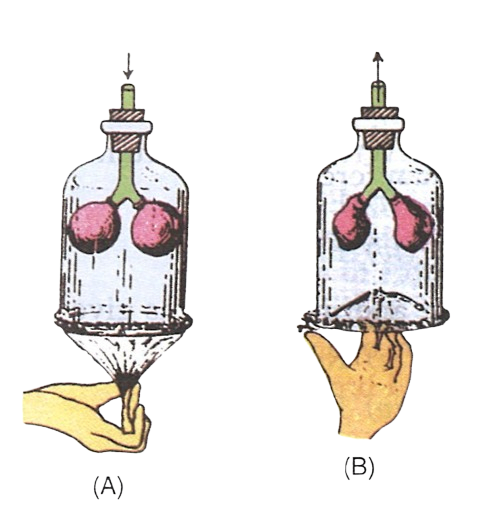
(i) Name the process and define it.
(ii) What are the two phases of the above mentioned process shown as (A) and (B) ?
(iii) Name the particular organs of the body shown in the figure with :
(a) Bell jar (b) Balloons (c) Rubber sheet(iv) How do these phases (A) and (B) differ with respect to the position of ribs ?
(v) Does the breathing rate of a young boy and an old person differ ? Explain.
The diagram given alongside shows the "Human Respiratory System". Study the same and answer the following questions :
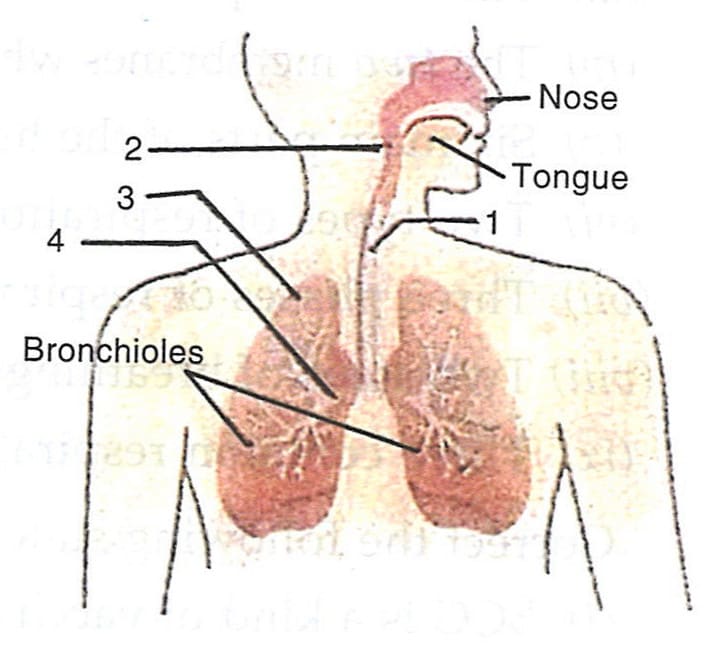
(i) Label the guidelines 1 to 4.
(ii) Define the structure shown as part 2.
(iii) Name the basic structural and functional unit of part 3.
(iv) Write one specific structural feature of the inner lining of part 1.
(v) What is the muscular sheet on which part 3 rests ?