Physics
Describe the construction and working of an electric bell with the help of a neat and labelled diagram.
Answer
Construction :
An electric bell is shown in below figure :
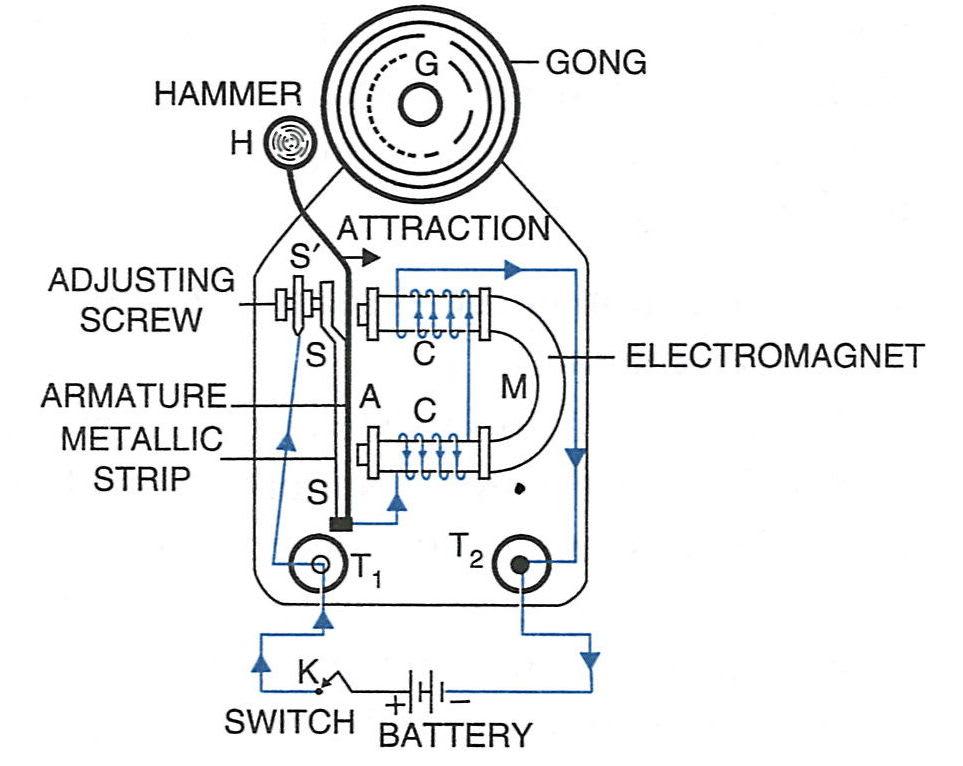
An electric bell consists of the following main parts:
(i) A horse-shoe electromagnet (M) with a soft iron core, wound with coils (CC) in opposite directions.
(ii) A soft iron armature (A) fixed to a metallic spring strip (SS).
(iii) A hammer (H) attached to the armature.
(iv) A gong (G) struck by the hammer.
(v) An adjusting screw (S’) to set the position of the armature.
(vi) A switch or bell-push (K).
(vii) A battery connected across the terminals (T₁ and T₂).
When the switch K is not pressed, the strip SS touches the screw S’, and the armature A remains away from the electromagnet poles.
Working :
When the switch K is pressed, current flows through the coils (CC) and magnetises the electromagnet. This attracts the armature A, causing the hammer H to strike the gong G, producing sound.
As the armature moves, contact between the strip SS and the screw S’ breaks, stopping the current. The electromagnet loses magnetism, and the spring strip pulls the armature back to its original position. Contact is re-established, current flows again, and the cycle repeats.
This make and break action continues rapidly, causing the hammer to strike the gong repeatedly while the switch is pressed.
Related Questions
Assertion (A) : Magnetic field lines never intersect each other.
Reason (R) : At a particular point, magnetic field has only one direction.
- both A and R are true and R is the correct explanation of A
- both A and R are true and R is not the correct explanation of A
- assertion is false but reason is true
- assertion is true but reason is false
Assertion (A) : Neutral points are the points at which two magnetic fields are equal in magnitude and in the same direction.
Reason (R) : The net magnetic field at a neutral point is zero.
- both A and R are true and R is the correct explanation of A
- both A and R are true and R is not the correct explanation of A
- assertion is false but reason is true
- assertion is true but reason is false
In a physics laboratory, a student places a bar magnet near a compass. At certain positions, the compass needle shows no deflection.
(a) Why does the compass needle show no deflection at certain points? What are these points called?
(b) What happens to the magnetic field lines at these points?
(c) Why are these points useful in studying magnetic fields?
(d) Are these points fixed, or do they change their positions?
Ravi observed that an electromagnet could lift iron pieces only when electric current was flowing through it. When the current was switched off, the iron pieces fell down.
(a) Why does an electromagnet lose its magnetism when the current stops?
(b) How is an electromagnet different from a permanent magnet?
(c) How can the strength of an electromagnet be increased?
(d) Why are electromagnets preferred in cranes?
(e) Which material is preferred for making the core of an electromagnet?