
Physics
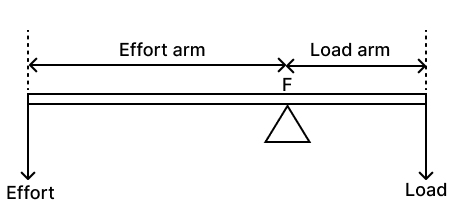
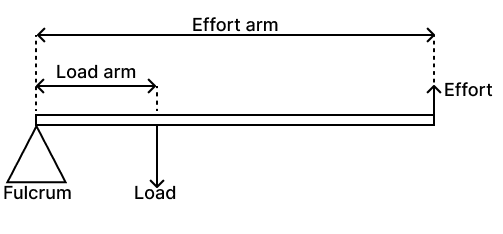
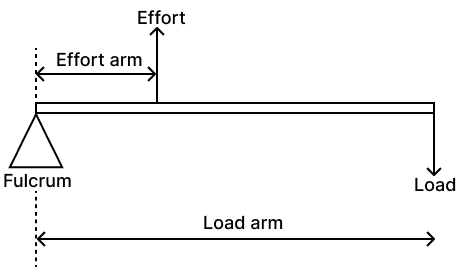
Describe three orders of levers giving an example of each. Draw neat diagrams showing the positions of fulcrum, load and effort in each kind of lever.
Machines
26 Likes
Answer
- Lever of Class I : The lever in which the fulcrum is in between the load and the effort are called lever of class I. Generally, the effort arm of lever of class I is longer than the load arm, therefore, the mechanical advantage of a class I lever is greater than 1. However, if the effort arm is equal to the load arm, the mechanical advantage is equal to 1. But if the effort arm is shorter than the load arm, its mechanical advantage is less than 1. Thus, the mechanical advantage of a lever of class I can be greater than 1, equal to 1 or less than 1. Example : see-saw.
- Lever of Class II : The lever in which the load is in between the fulcrum and the effort are called lever of class II. In class II lever, the fulcrum is at one end and the load is closer to the fulcrum. Thus, the effort arm is always longer than the load arm. Hence, the mechanical advantage of a class II lever is always more than 1. Example : nut cracker.
- Lever of Class III : The lever in which the effort is in between the fulcrum and the load are called lever of class III. In class III lever, the fulcrum is at one end and the effort is close to the fulcrum, thus the effort arm is always shorter than the load arm. Hence, the mechanical advantage of a class III lever is always less than 1. Example : knife.
Answered By
14 Likes
Related Questions
Select the correct statement :
(a) A wheel barrow is a lever of class I.
(b) The efficiency of a machine is always 100%.
(c) Friction in moving parts of a machine reduces its efficiency.
(d) No lever has the mechanical advantage greater than 1.
(e) It is easier to lift a load vertically up than to push it along an inclined plane.
(f) A screw is made by two inclined planes placed together.
Name six simple machines. Give an example of each machine.
Draw diagrams to illustrate the positions of fulcrum, load and effort, in each of the following :
(a) a see-saw
(b) a beam balance
(c) a nut cracker
(d) a pair of forceps
The mechanical advantage of an actual pulley is less than 1. Give a reason. What is the justification for using the pulley then?