
Computer Applications
Design a class to overload a function series( ) as follows:
(a) void series (int x, int n) – To display the sum of the series given below:
x1 + x2 + x3 + ………. xn terms
(b) void series (int p) – To display the following series:
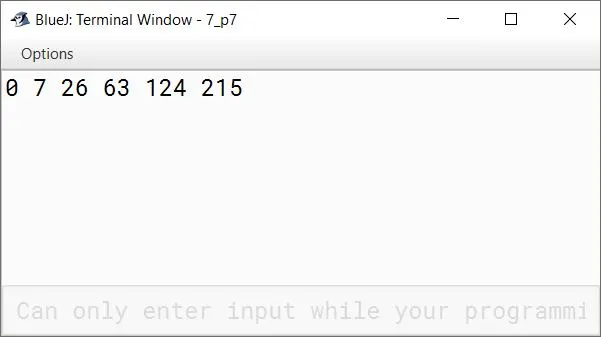
0, 7, 26, 63 ………. p terms
(c) void series () – To display the sum of the series given below:
1/2 + 1/3 + 1/4 + ………. 1/10
Java
User Defined Methods
ICSE 2019
185 Likes
Answer
public class KboatOverloadSeries
{
    void series(int x, int n) {
        long sum = 0;
        for (int i = 1; i <= n; i++) {
            sum += Math.pow(x, i);
        }
        System.out.println("Sum = " + sum);
    }

    void series(int p) {
        for (int i = 1; i <= p; i++) {
            int term = (int)(Math.pow(i, 3) - 1);
            System.out.print(term + " ");
        }
        System.out.println();
    }

    void series() {
        double sum = 0.0;
        for (int i = 2; i <= 10; i++) {
            sum += 1.0 / i;
        }
        System.out.println("Sum = " + sum);
    }
}
Output


Answered By
65 Likes
Related Questions
Define a class to overload the method perform as follows:
double perform (double r, double h) — to calculate and return the value of curved surface area of cone
void perform (int r, int c) — Use NESTED FOR LOOP to generate the following format
r = 4, c = 5
output
1 2 3 4 5
1 2 3 4 5
1 2 3 4 5
1 2 3 4 5void perform (int m, int n, char ch) — to print the quotient of the division of m and n if ch is Q else print the remainder of the division of m and n if ch is R
Method which reverses a given number is:
- Impure method
- Pure method
- Constructor
- Destructor