
Mathematics
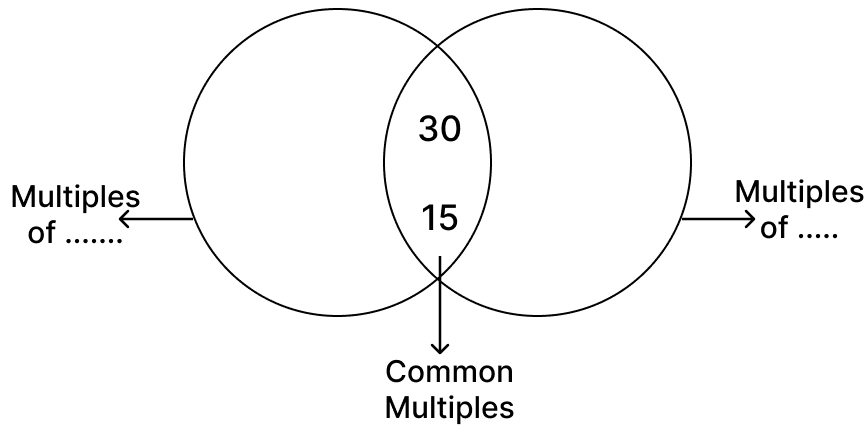
In the diagram below, Aditya has erased all the numbers except the common multiples. Fill in the missing numbers in the empty regions, if the highest number in the diagram is 30.
Number Play
1 Like
Answer
The common multiples shown are 15 and 30. So the two circles represent multiples of two numbers whose common multiples (up to 30) include 15 and 30.
The two numbers must be factors of 15 (excluding 1 and 15 themselves, as the circles need separate non-common multiples in the highest range up to 30).
The factors of 15 are 1, 3, 5 and 15. So the two numbers are 3 and 5.
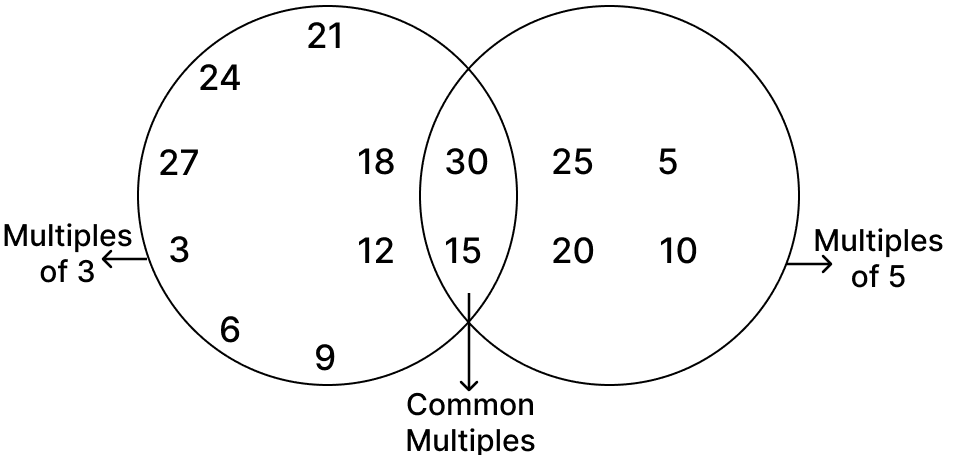
Multiples of 3 (up to 30, excluding common multiples): 3, 6, 9, 12, 18, 21, 24, 27.
Multiples of 5 (up to 30, excluding common multiples): 5, 10, 20, 25.
Common multiples (already given): 15, 30.
Hence, the left circle represents Multiples of 3 (containing 3, 6, 9, 12, 18, 21, 24, 27), the right circle represents Multiples of 5 (containing 5, 10, 20, 25), and the common region contains 15 and 30.
Answered By
2 Likes
Related Questions
Write all pairs of 2-digit twin primes such that on changing the places of their digits, they still remain prime numbers.
There are just four natural numbers less than 100, which have exactly three factors. One of them is 25, what are the other three? What can be said about these numbers?
Find two positive integers such that their product is 1,00,000 and none of them contains 0 as a digit.
2024 is a leap year (as February has 29 days). Leap years occur in the years that are multiples of 4, except for those years that are divisible by 100 but not 400.
(i) From the year you were born till now, which years were leap years?
(ii) From the year 2024 till 2099, how many leap years are there?