
Mathematics
The diagram shows a nest of 4 squares set one within another. The side of the outer most square is 20 cm. The midpoints of the sides are joined to give a second square, and the process is repeated to give the third and fourth squares. Find the length of a side of the smallest square.

Pythagoras Theorem
2 Likes
Answer
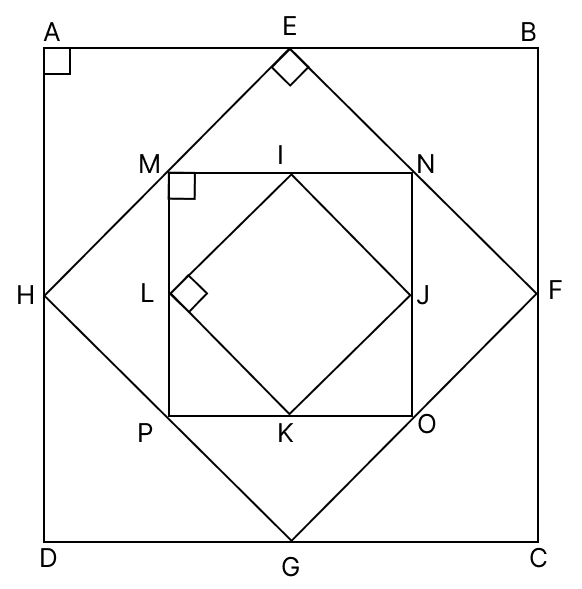
Given, squares are formed joining mid-points of square ABCD.
AE = AH = × AB = × 20 = 10 cm.
In square ABCD,
∠A = 90°
By Pythagoras theorem,
Hypotenuse2 = Perpendicular2 + Base2
In triangle AEH,
⇒ EH2 = AE2 + AH2
⇒ EH2 = 102 + 102
⇒ EH2 = 100 + 100
⇒ EH2 = 200
⇒ EH =
⇒ EH = cm.
In square EFGH,
∠E = 90°
EM = EN = × EH =
By Pythagoras theorem,
In triangle EMN,
⇒ MN2 = EN2 + EM2
⇒ MN2 =
⇒ MN2 = 50 + 50
⇒ MN2 = 100
⇒ MN =
⇒ MN = 10 cm.
In square MNOP,
∠M = 90°
IM = ML =
By Pythagoras theorem,
In triangle IML,
⇒ IL2 = IM2 + ML2
⇒ IL2 = 52 + 52
⇒ IL2 = 25 + 25
⇒ IL2 = 50
⇒ IL =
⇒ IL = cm.
Hence, the length of a side of the smallest square is cm.
Answered By
1 Like
Related Questions
The hypotenuse of a right triangle is 25 cm. If out of the two legs, one is longer than the other by 5 cm, then the sum of the lengths of the legs is:
30 cm
35 cm
40 cm
45 cm
An aeroplane leaves an airport and flies due North at 300 km/h. At the same time, another plane leaves the same airport and flies due West at 400 km/h. After 90 minutes, the distance between the two planes would be:
1000 km
900 km
800 km
750 km
For going to city B from city A, there is a route via city C such that AC ⟂ CB, AC = 2x km and CB = 2(x + 7) km.
It is proposed to construct a 26 km highway which directly connects the two cities A and B. Find how much distance will be saved in reaching city B from city A after the construction of the highway.
A 5 m long ladder is placed leaning towards a vertical wall such that it reaches the wall at a point 4 m high. If the foot of the ladder is moved 1.6 m towards the wall, then find the distance by which the top of the ladder would slide upwards on the wall.