Mathematics
Directions (Q. 53 to 56): Study the following diagram carefully and answer the given questions:
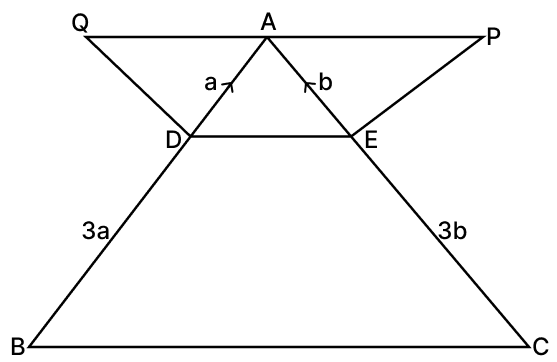
In ΔABC, D and E are points on AB and AC respectively such that AD = a, DB = 3a, AE = b and EC = 3b. DQ ∥ EA and EP ∥ DA are drawn. QP is joined.
53. ΔADE is similar to which of the following triangles?
I. ΔABC
II. ΔDAQ
III. ΔADQ
IV. ΔEPA
V. ΔEAP
I, II and IV only
I, III and V only
I, II and V only
I, III and IV only
54. If DE = 2 cm, then BC is equal to:
4 cm
6 cm
7 cm
8 cm
55. The ratio of the perimeters of ΔADE and ΔABC is:
1 : 2
1 : 3
1 : 4
1 : 6
56. The ratio of the areas of ΔADE and trapezium DBCE is:
1 : 8
1 : 9
1 : 15
1 : 16
Similarity
1 Like
Answer
53. Given,
In ΔADE and ΔABC,
∠A is common.
By SAS Similarity of Triangles, ΔADE ∼ ΔABC.
In ΔADE and ΔDAQ,
∠DQA = ∠ADE [Corresponding angle]
∠QDA = ∠DAE [Alternate Interior Angle]
∴ ΔADE ∼ ΔDAQ by AA similarity
In ΔADE and ΔEPA,
∠EPA = ∠ADE [Corresponding angle]
∠PEA = ∠DAE [Alternate Interior Angle]
∴ ΔADE ∼ ΔEPA by AA similarity
Hence, option 1 is the correct option.
54. Given,
Since ΔADE ∼ ΔABC, corresponding sides are proportional.
Given AD = a and DB = 3a, so AB = 4a.
Hence, option 4 is the correct option.
55. Given,
Hence, option 3 is the correct option.
56. Given,
Hence, option 3 is the correct option.
Answered By
1 Like
Related Questions
Directions (Q. 45 to 48): Using the given diagram answer the following questions.
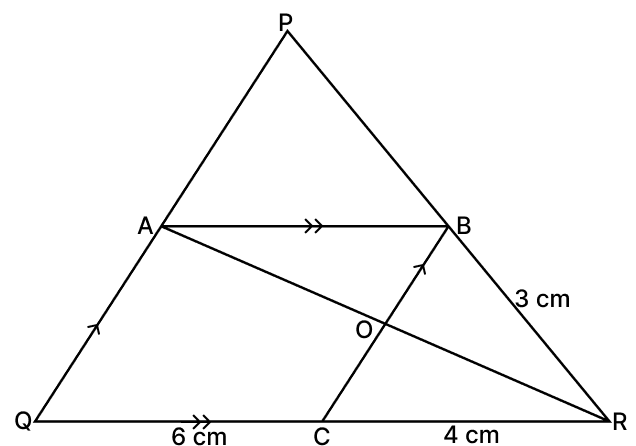
In ΔPQR, AB ∥ QR, QP ∥ CB and AR intersects CB at O.
45. The triangle similar to ΔARQ is:
ΔORC
ΔARP
ΔOBR
ΔQRP
46. ΔPQR ∼ ΔBCR by axiom:
SAS
AAA
SSS
AAS
47. If QC = 6 cm, CR = 4 cm, BR = 3 cm, then the length of RP is:
4.5 cm
5 cm
7.5 cm
8 cm
48. The ratio PQ : BC is:
2 : 3
3 : 2
2 : 5
5 : 2
Directions (Q. 49 to 52): Answer these questions on the basis of the following information:
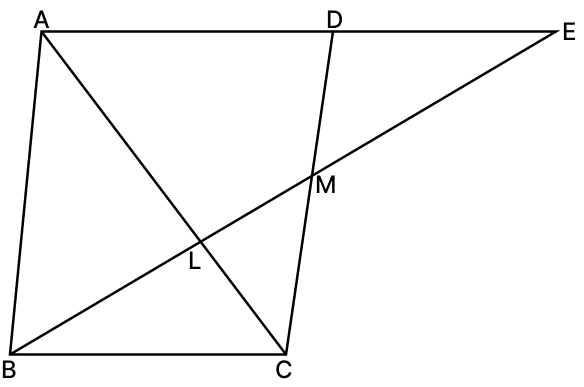
Through the mid-point M of the side CD of a ∥gm ABCD, the line BM is drawn, intersecting AC on L and AD produced in E.
49. Which of the following is true for triangles BMC and EMD ?
I. They are similar to each other.
II. They are congruent to each other.
III. Their areas are equal.
IV. Their perimeters are equal.
I and II
II and III
I and III
I, II, III and IV
50. ΔAEL is similar to:
ΔCBL
ΔCML
ΔDME
ΔBMC
51. By which axiom are the above triangles similar?
AA
SSS
SAS
ASA
52. EL : BL is equal to :
1 : 2
2 : 1
1 : 3
3 : 1
Directions (Q. 57 to 60): Study the given information and answer the questions that follow:
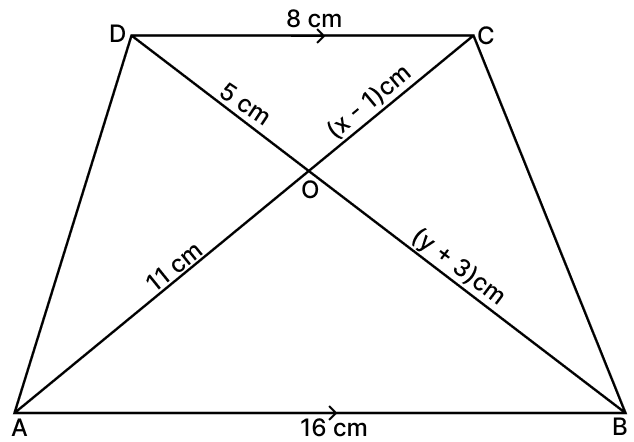
In the given figure ABCD is a trapezium in which DC is parallel to AB. AB = 16 cm and DC = 8 cm, OD = 5 cm, OB = (y + 3) cm, OA = 11 cm and OC = (x − 1) cm.
57. From the given figure name the pair of similar triangles :
ΔAOD, ΔOBC
ΔCOD, ΔAOB
ΔADB, ΔACB
ΔCOD, ΔCOB
58. The corresponding proportional sides with respect to the pair of similar triangles obtained above is :
59. The ratio of the sides of the pair of similar triangles is:
1 : 3
1 : 2
2 : 3
3 : 1
60. Using the ratio of sides of the pair of similar triangles, the values of x and y are respectively :
x = 4.6, y = 7
x = 7, y = 7
x = 6.5, y = 7
x = 6.5, y = 2
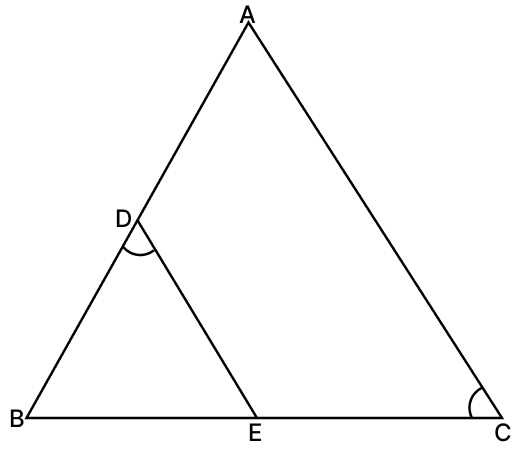
Assertion (A): In the figure, if ∠EDB = ∠ACB, BE = 6 cm, EC = 4 cm and BD = 5 cm, then the length of AB is 12 cm.
Reason (R): If two triangles have two pairs of corresponding angles equal, then the triangles are similar.
A is true, R is false.
A is false, R is true.
Both A and R are true.
Both A and R are false.