Science
The domes of many building in Europe are made of copper. These domes now appear greenish in colour.
(a) Why do the domes appear greenish though copper is orange-red in colour?
(b) In your opinion, should the copper domes be replaced by iron domes to overcome the problem of change of colour of copper domes?
(c) Domes used to be made from thin sheets of metals. Why did the ancient architects use copper to make domes?
Answer
(a) The domes appear greenish because the copper surface reacts with moist air and carbon dioxide over time, forming a layer of basic copper carbonate (CuCO3·Cu(OH)2), which is greenish in colour. Although copper is originally orange-red, the formation of this compound gives the dome its characteristic greenish appearance.
(b) The copper domes should not be replaced with iron domes since iron reacts with moisture and oxygen to form iron oxide (rust), which is reddish-brown and flakes off, exposing fresh metal to further corrosion which makes iron weak and unstable over time. In contrast, the green coating on copper forms a protective layer that prevents further corrosion, keeping the dome strong and durable.
(c) Ancient architects used copper because it is a highly malleable metal, its thin sheets can be used to give different shapes of roofs, like the shape of a dome.
Related Questions
The following activity is set-up in the science lab by the teacher. He clamped an aluminium wire on a stand and fixed a pin to the free end of the wire using wax. Then he heated the wire with a burner from the end where the wire is clamped. Students observed the pin fall off.

(a) If the teacher replaces aluminium wire by silver wire, will the students’ observation change? Justify your answer.
(b) Will the aluminium wire melt? Give reason for your answer.
An element ‘X’ is stored in kerosene and cannot be extracted from its ore using a reducing agent. ‘X’ forms an ionic compound on reaction with chlorine.
(a) Can we store ‘X’ in water? Give reason to support your answer.
(b) Identify element ‘X’. Name the process used and write the equation for extraction of ‘X’ from its ore.
Amrita electrolysed distilled water using the set-up shown in figure 1. She was expecting two gases to be evolved at the anode and cathode respectively.

Suddenly, she realised that the bulb in the circuit did not glow when she used distilled water (figure 2)
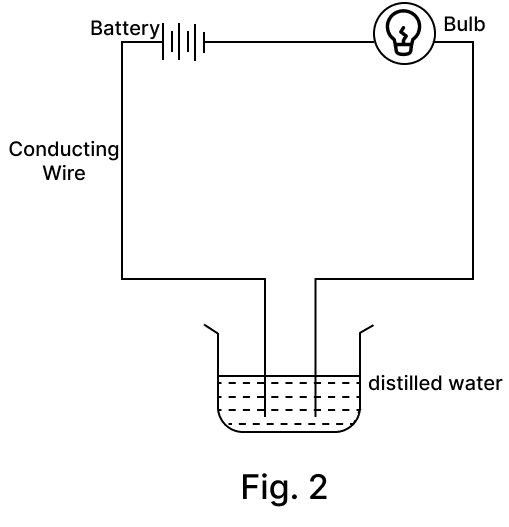
After this realization, she added a substance to the distilled water for electrolysis to take place.
Answer the following questions based on the information given above:
(a) Which gas was she expecting to be formed at the anode and which one at the cathode respectively?
(b) Why did the bulb not glow when Amrita passed electricity through distilled water?
(c) Which substance was added by Amrita to distilled water to get the expected result?