Biology
Draw a labelled diagram of the inner ear. Name the part of the inner ear that is responsible for static balance in human beings.

Related Questions
The figure given below shows the principal parts of a human ear. Study the diagram and answer the following questions.

(a) Label the parts 1 to 8.
(b) State the role of parts 6, 7 and 8.
(c) Why is it harmful to use a sharp object to remove ear wax? Mention the number and name of the part involved.
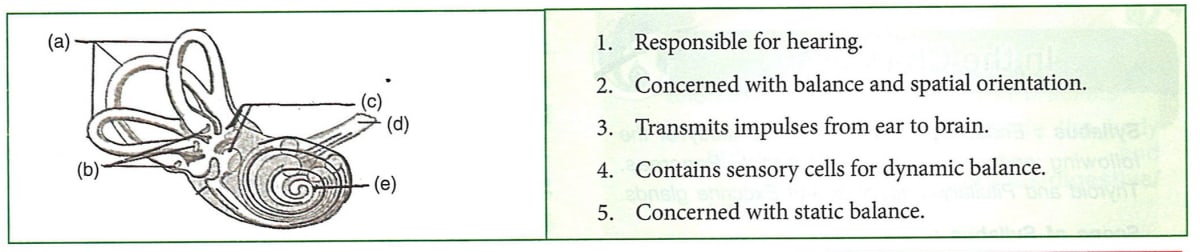
Given below is the internal structure of the human ear. Match the structures marked (a) to (e) with their correct function.
Aman's father, aged 50 years, is suffering from an eye defect. He can see the distant objects clearly but not the nearby ones. He keeps the newspaper and books far away from his eyes to read. Answer the following questions :
(a) Identify the eye defect.
(b) Mention the possible reason for this defect.
(c) What kind of lens can be used to correct this defect?
(d) Name the structure in the human eye which holds the lens in proper position and attaches it to the ciliary body.
The eye is sensitive to light and is responsible for vision. The main parts of an eye are sclera, cornea, retina and lens. Lens passes the light rays to the retina through vitreous humour. Retina is the sensitive layer of the eye which contains sensory cells for image formation. The impulses of the image are then carried from retina to the brain through optic nerves.
(i) Lens is filled in front of the eye ball between aqueous humour and vitreous humour, which has the following characteristic features :
- Biconvex, translucent and richly supplied with blood vessels.
- Oval shaped, transparent and elastic in nature.
- Biconvex, flexible and non-vascular.
- Both 1 and 3
(ii) The sensory cells of the eye - rods and cones are located on the retina and help in image formation. If cones of a person are damaged or diminished in number, what will be its effect ?
- Person will be able to see better in bright light.
- Person will be able to see better in dim light.
- Person will be unable to distinguish between different colours.
- Both 2 and 3