
Mathematics
Draw ∠AOB = 76° with the help of a protractor. Bisect this angle by using a ruler and compass. Measure the two parts by your protractor and see how accurate you are.
Constructions
1 Like
Answer
Steps:
Draw a ray OA.
Place the centre of the protractor at O and the zero line along OA. Mark a point at 76°.
Remove the protractor and join O with the marked point and produce it to B. Then ∠AOB = 76°.
With O as centre and any suitable radius, draw an arc to meet ray OA at C and ray OB at D.
With C as centre and any suitable radius , draw an arc. Also, with D as centre and the same radius, draw another arc to meet the previous arc at E.
Join OE and produce it to form ray OE.
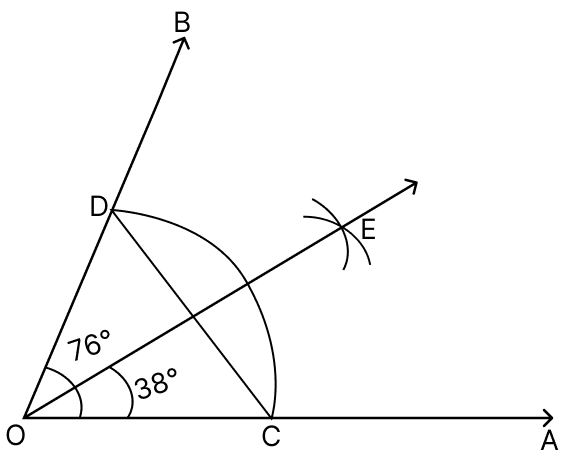
Then OE is the bisector of ∠AOB.
On measuring the two parts with a protractor, we find:
∠AOE = 38° and ∠EOB = 38°.
Hence, ray OE bisects ∠AOB into two equal parts of 38° each.
Answered By
1 Like
Related Questions
Draw a line segment of length 5.4 cm. Construct a perpendicular at A by using a ruler and compass.
Draw a line segment of length 6.8 cm. Draw a perpendicular to it from a point A outside PQ by using a ruler and compass.
Draw a line segment of length 6.5 cm and construct its axis of symmetry.
By using a ruler and compass, construct an angle of 135° and bisect it. Measure any one part by protractor and see how accurate you are.