
Mathematics
Draw a circle and any two of its (non-perpendicular) diameters. If you join the ends of these diameters, what is the figure obtained? What figure is obtained if the diameters are perpendicular to each other?
Constructions
1 Like
Answer
Steps:
Mark a point O as the centre of the circle and draw a circle of any suitable radius with O as centre.
Draw any two diameters AC and BD of the circle which are not perpendicular to each other.
Join the ends A, B, C and D in order.
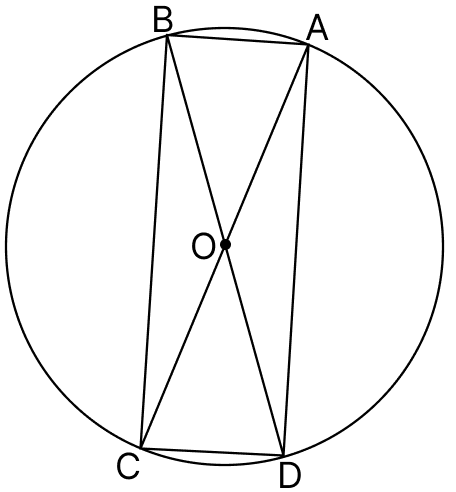
The figure obtained on joining the ends of the two non-perpendicular diameters is a rectangle.
When the two diameters are perpendicular to each other, the figure obtained on joining the ends of the diameters is a square.
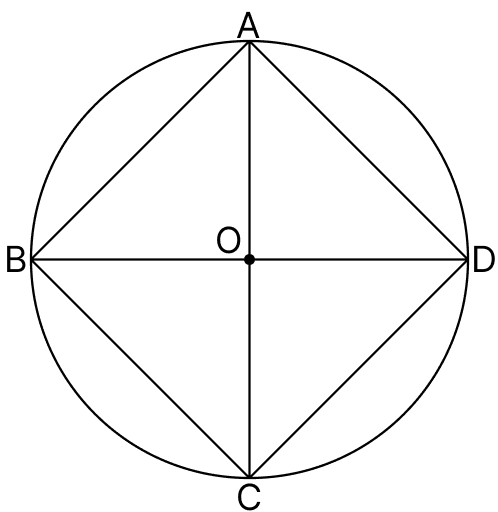
Hence, the figure obtained is a rectangle and a square when diameters are perpendicular to each other.
Answered By
1 Like
Related Questions
With the same centre O, draw two circles of radii 2.6 cm and 4.1 cm.
Draw any circle and mark points A, B and C such that
(i) A is on the circle.
(ii) B is in the interior of the circle.
(iii) C is in the exterior of the circle.
Let A, B be the centres of two circles of equal radii; draw them so that each one of them passes through the centre of the other. Let them intersect at C and D.
Examine whether are at right angles.
Construct a line segment of length 6.3 cm using ruler and compass.