Mathematics
Draw a rough sketch of a regular hexagon. Connecting three of its vertices draw:
(i) an isosceles triangle
(ii) a right-angled triangle.
Polygons
2 Likes
Answer
A regular hexagon has 6 equal sides and 6 equal interior angles.
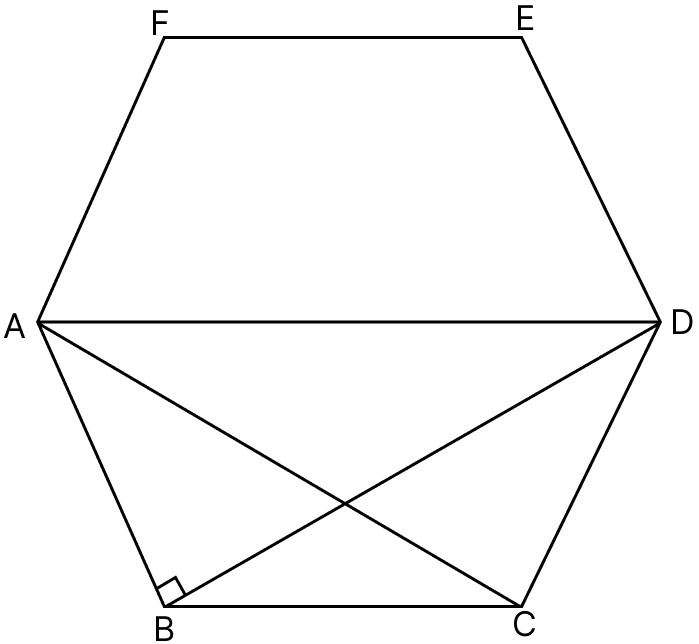
(i) Isosceles triangle: Connecting vertices A, B and C of the hexagon ABCDEF, we get triangle ABC in which two sides are equal. So, ABC is an isosceles triangle.
(ii) Right-angled triangle: Connecting vertices A, B and D of hexagon ABCDEF (where AD is a diameter of the hexagon).
As we know that all interior angles of a regular hexagon = 120°. Since, all sides of a regular hexagon are equal that means BC = CD, therefore, BCD is an isosceles triangle,
∠CBD = ∠CDB (Angles opposite to equal sides are equal)
As this is a regular hexagon, ∠C = 120°
Now sum of all angles of triangle BCD,
∠CBD + ∠CDB + ∠C = 180°
2∠CBD + 120° = 180°
2∠CBD = 180° - 120° = 60°
∠CBD = 30°
As, ∠ABD + ∠CBD = ∠B = 120°
∠ABD + 30° = ∠B = 120°
∠ABD = 120° - 30°
∠ABD = 90°
So, we get a right-angled triangle ABD with the right angle at B.
Answered By
2 Likes