
Chemistry
Electroplating steel objects with silver involves a three-step process.
Step 1 — A coating of copper is applied to the object.
Step 2 — A coating of nickel is applied to the object.
Step 3 — The coating of silver is applied to the object.
(a) A diagram of the apparatus used for step 1 is shown.

The chemical process taking place on the surface of the object is
Cu2+(aq) + 2e- ⟶ Cu (s)
What is the observation seen on the surface of the object?Explain why the concentration of copper ions in the electrolyte remains constant throughout step 1.
(b) Give two changes which would be needed in order to coat nickel onto the object in step 2.
(c) Write down the reaction taking place at the positive electrode during step 3.
Electrolysis
ICSE Sp 2025
53 Likes
Answer
(a)
- The object will develop a coating of copper. Visually, this results in the object taking on a reddish-brown appearance due to the deposition of metallic copper. Also there is an increase in mass of the steel object.
- As copper ions are reduced and deposited onto the object, an equal amount of copper metal is oxidised from the anode to maintain the concentration of Cu2+ in the electrolyte solution.
(b) Two changes which would be needed in order to coat nickel onto the object in step 2 are:
- Replace the copper sulphate solution with a nickel-containing electrolyte solution, such as nickel sulphate.
- Replace the copper anode with a nickel anode.
(c) Ag (s) ⟶ Ag+(aq) + e-
Answered By
33 Likes
Related Questions
Which of the following about oxides is correct?
- A basic oxide is an oxide of a non-metal
- Acidic oxides contain ionic bonds
- Amphoteric oxides contain a metal
- Basic oxides are always gases
A student takes Cu, Al, Fe and Zn strips, separately in four test tubes labeled as I, II, III and IV respectively. He adds 10 ml of freshly prepared ferrous sulphate solution to each test tube and observes the colour of the metal residue in each case.
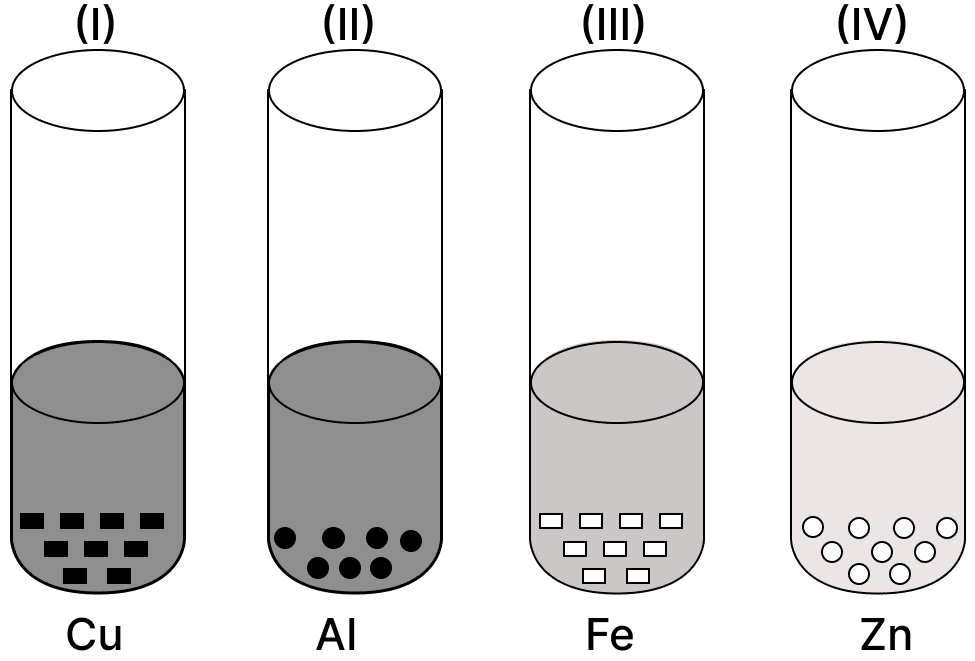
He would observe a black residue in the test tubes:
- (I) and (II)
- (I) and (III)
- (II) and (III)
- (II) and (IV)
Match the following Column A with Column B.
Column A Column B Aluminium Covalent compound Sulphuric acid Carbonate ore Calcination Hall Heroult’s process Calcium Chloride Contact Process Carbon tetrachloride Electrovalent compound Complete the following by choosing the correct answers from the bracket:
(a) If an element has one electron in the outermost shell, then it is likely to have the …………… [smallest/largest] atomic size amongst all the elements in the same period.
(b) …………… [sulphuric acid/hydrochloric acid] does not form an acid salt.
(c) A …………… [reddish brown/dirty green] coloured precipitate is formed when ammonium hydroxide is added to a solution of ferrous chloride.
(d) Alkynes undergo …………… [addition/substitution] reactions.
(e) An …………… [alkaline/acidic] solution will turn methyl orange solution pink or red.