Physics
An element emits one α-particle and then two β-particles consecutively to form an element Q.
(a) Show all the transformations by means of equations only.
(b) What are P and Q called?
Radioactivity
7 Likes
Answer
(a)
(b) Isotopes, because they have the same atomic number but different mass number.
Answered By
5 Likes
Related Questions
The diagram below shows a pulley used to lift an iron beam of length 3 m and weight 100 kgf, lying on the ground.
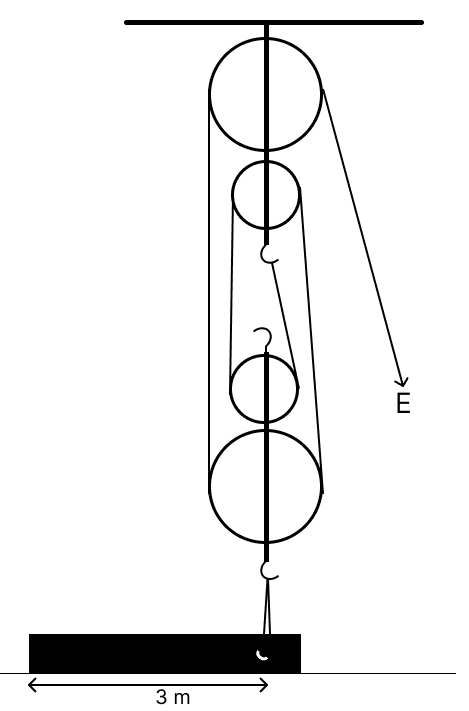
(a) Calculate the minimum effort needed to just lift the beam off the ground. [Assume no loss of energy]
(b) When the beam is being lifted from the ground, with the other end touching the ground, state with a reason whether the effort needed keeps on increasing, decreasing or remains constant.
You are doing an experiment on the refraction of light in your Physics laboratory. ABCD is a rectangular block. A ray of light is incident obliquely on the surface AB.
(a) Draw the path of the ray of light through the glass block and also show how it emerges from the block. [ The diagram should show the lateral displacement suffered by the ray.]
(b) Which two pairs of angles remain the same during the experiment?
(c) If the same experiment is performed first with red and then with blue light, which colour will suffer greater lateral displacement?
In the graph, a given quantity of ice is converted to water.
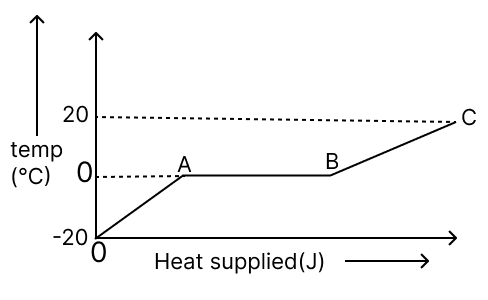
(a) What does the portion AB represent?
(b) Why is the portion AB parallel to the time axis?
(c) Why is the slope OA steeper than the slope BC?
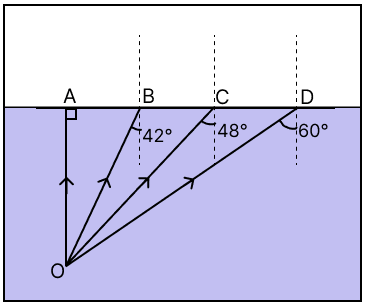
In the given diagram, two transparent optical media are shown. The rarer medium is air, while the denser medium is water. Redraw the diagram by showing the paths of the rays after striking the surface of separation AD for the incident rays OA, OB, OC and OD, respectively. (Critical angle for the denser medium = 48°)