
Commercial Applications
Elucidate the selection procedure for a vacancy in an organisation.
Recruitment
3 Likes
Answer
The selection procedure for a vacancy in an organisation generally involves the following steps:
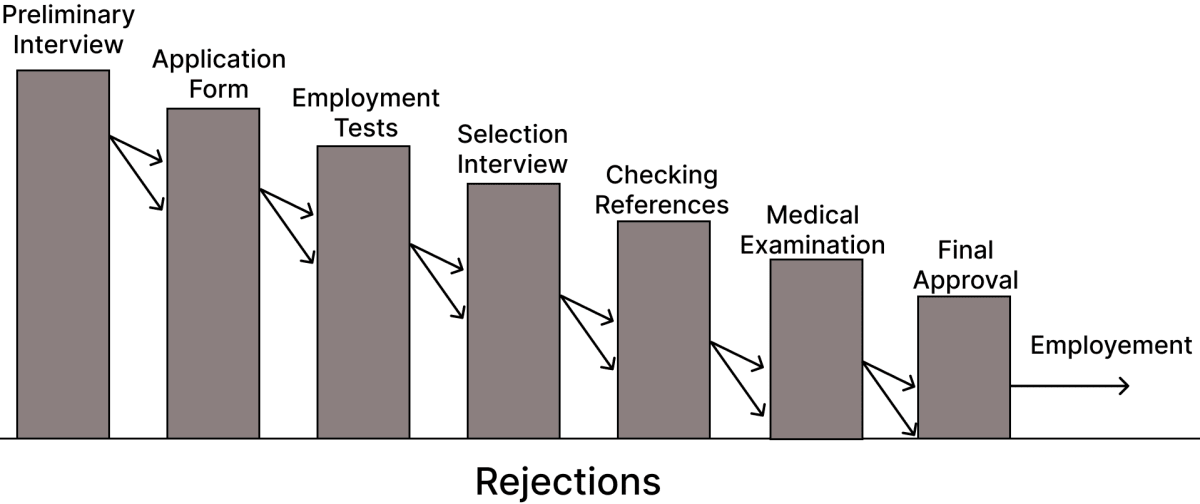
Preliminary Interview — This is the first occasion when candidates come into contact with the company's officials. A brief interview is conducted by the receptionist or some other official to ascertain the minimum qualifications, experience, age, etc., of candidates. Candidates who are obviously unfit are rejected at this stage.
Application Form — Candidates who succeed in the preliminary interview are asked to fill in the prescribed application form. The form provides a written record of the name, address, age, qualifications, work experience, etc., of a candidate. It serves as the basis for further interview.
Employment Tests — Tests are conducted to assess the work behaviour and capabilities of candidates. Various tests like achievement tests, intelligence tests, aptitude tests, personality tests, and interest tests may be used to identify suitable candidates.
Selection Interview — A purposeful exchange of ideas and information between the candidate and the employer takes place. The interview helps in checking the information obtained through application form and tests, and assessing the personality, communication skills, and suitability of the candidate.
Checking References — Candidates are required to give names and addresses of two or three persons (called 'references') from whom information about the candidate may be obtained. References may be heads of educational institutions or previous employers, who provide information in confidence about the candidate's competence and character.
Medical Examination — A physical examination of the candidates is conducted to ensure they are physically fit for the job. It also protects the employer against future claims for compensation. Medical examination records complete medical history, current physical capabilities, and nature of disabilities, if any.
Final Approval — Candidates short-listed after the medical examination are finally approved by the head of the department. They are issued appointment letters and/or service agreements. They are usually appointed on probation of one or two years and made permanent after satisfactory performance.
After selection, the candidates are assigned specific jobs and workplaces, which is called placement.
Answered By
3 Likes
Related Questions
The system of Teacher Education holds the key responsibility in the making of professionally qualified and competent teachers. An effective teacher must have a positive attitude towards teaching as a profession, commitment and dedication towards teaching as a function. A profession is a specialized occupation involves specific orientation and training.
The purpose of a code of professional ethics for academic staff is to provide guidance in exercising the ethical responsibilities inherent in a profession.
(a) State and explain any two external sources of recruitment for academic staff.
(b) Suggest any two types of training to enhance teacher's proficiency.
(c) Suggest any two primary professional obligations of school teachers towards students.
Explain in brief the external sources of recruitment.
OR
Discuss any two external sources of recruitment.
Explain any two types of interviews conducted by an enterprise in the selection of its employees.
OR
Discuss any two types of interviews.
Explain any five steps generally involved in the selection of employees.