
Physics
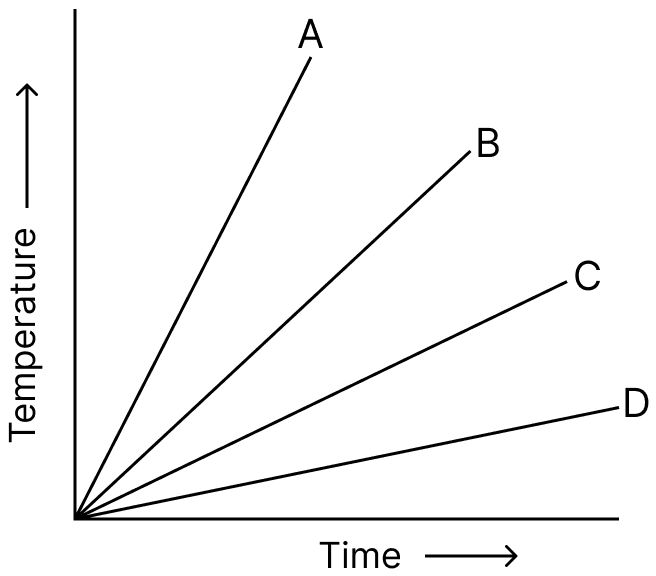
(i) Equal masses of four different substances are heated such that the rate of heat supply is same. The rise in temperature with respect to time is plotted on a graph. Which of the following substances has the highest specific heat capacity ?
- A
- B
- C
- D
(ii) Would you use this material for making a calorimeter? Give reason for your answer.
Calorimetry
6 Likes
Answer
(i) D
(ii) No
Reason —
(i) When equal masses of substances are heated at the same rate, the rise in temperature depends on the specific heat capacity using
Q = mcΔT
where
- m is mass,
- c is specific heat capacity, and
- Δt is the change in temperature.
For the same heat supplied and mass, a substance with higher specific heat capacity shows a smaller rise in temperature, i.e., a less steep slope on the graph.
Since curve D has the least slope, it corresponds to the highest specific heat capacity.
Hence, substance D has the highest specific heat capacity.
(ii) A calorimeter should be made of a material having low specific heat capacity, so that it absorbs very little heat itself.
But this substance has the highest specific heat capacity, so it will absorb more heat, which is not suitable for a calorimeter.
Therefore, this material is not suitable for making a calorimeter.
Answered By
1 Like
Related Questions
Write down the approximate range of temperature at which water boils in a pressure cooker.
Complete the following sentences:
- When ice melts, it's volume ……………
- Decrease in pressure over ice …………… it's melting point.
- Increase in pressure …………… the boiling point of water.
- A pressure cooker is based on the principle that boiling point of water increases with the ……………
- The boiling point of water is defined as ……………
- Water can be made to boil at 115°C by …………… pressure over it's surface.
A substance on heating undergoes (i) a rise in it's temperature, (ii) a change in it's phase without change in it's temperature. In each case, state the change in energy of molecules of the substance.
How does the (a) average kinetic energy (b) average potential energy of molecules of a substance change during it's change in phase at a constant temperature, on heating?