Physics
Equal volumes of water are added to three cylindrical jars A, B and C of same height and radii rA, rB and rC respectively with rB < rA < rC. If you blow air into the mouth of these jars, which tube will produce the shrillest note?
- A
- B
- C
- All will produce the notes of same shrillness
Answer
B
Reason — When air is blown across the mouth of a jar, the pitch of the sound depends on the length of the air column above the water. A shorter air column produces a higher-pitched (shriller) sound, while a longer air column produces a lower pitch.
As, volume of a cylindrical jar is given by,
Volume = πr2h
Where r is the radius and h is the height of the jar and since equal volumes of water are poured into jars with radii rB < rA < rC, the jar with the smallest radius (B) will have the greatest height of water, leaving the shortest air column.
Therefore, jar B produces the shrillest note.
Related Questions
Assertion (A) : Tiny air molecules scatter blue light more than red light.
Reason (R) : The refractive index of a medium is greater for blue light than red light.
- (A) is true but (R) is false.
- (A) is false but (R) is true.
- Both (A) and (R) are true and (R) is correct explanation of (A).
- Both (A) and (R) are true and (R) is not the correct explanation of (A).
In the circuit given below, identify the lamp (L1, L2, L3 and L4) whose failure would not interrupt the power supply to the other lamps.
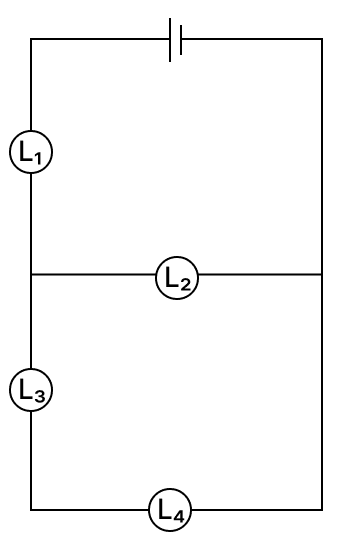
- L1
- L2
- L3
- L4
A metallic wire is stretched in such a way that its new length becomes twice the original length. How does its specific heat capacity change?
- becomes double
- becomes 4 times
- becomes 1⁄4 times
- remains the same