
Commercial Applications
Explain briefly the various elements of cost.
OR
Explain the elements of total cost.
Cost
2 Likes
Answer
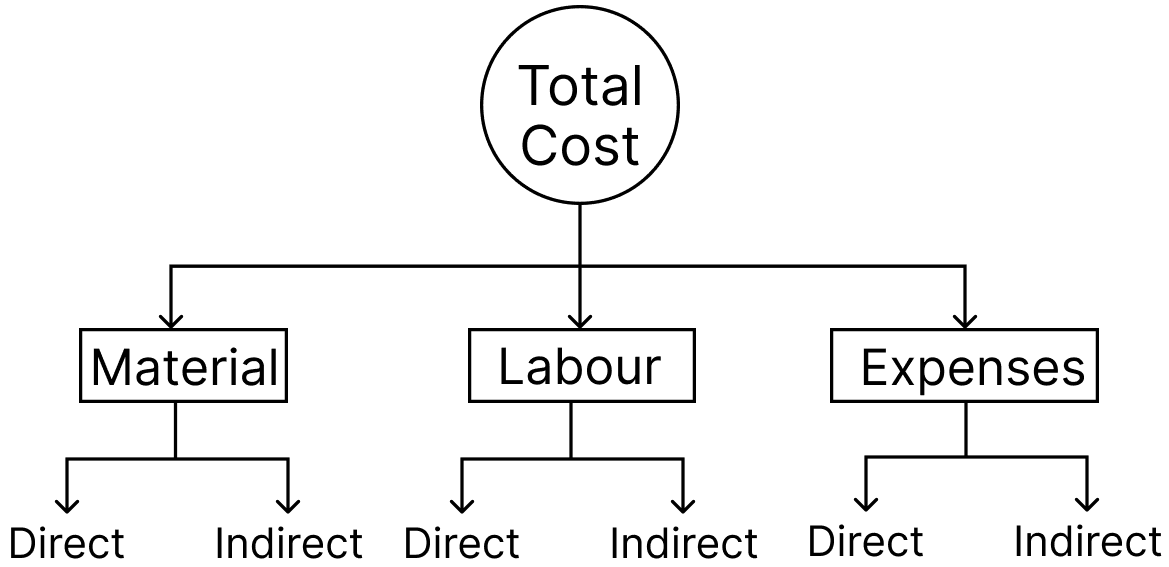
There are three basic elements of cost — Material, Labour and Expenses. Each of these can be further sub-classified into direct and indirect.
1. Material Cost
Material cost is the cost of substances from which the product is made. Examples: paper in a book, plastic in a ball pen, timber in furniture.
- Direct Material — Materials that become an integral part of the finished product and can be directly charged to it. Example: cloth in dress making.
- Indirect Material — Materials that cannot be directly assigned to a specific product. Example: oil, grease, consumable stores.
2. Labour Cost
Labour cost is the cost of human effort. It is the total remuneration paid to workers, supervisors and managers.
- Direct Labour — Labour wholly and directly identified with a particular product. Example: wages paid to a machine operator, wages of a carpenter in a furniture factory.
- Indirect Labour — Labour that cannot be directly identified with a particular product. Example: wages of storekeeper, foreman, timekeeper.
3. Expenses
Expenses are costs incurred other than on material and labour, for production, distribution and management of the organisation.
- Direct Expenses — Expenses directly identifiable with a specific product. Example: hire charges of a machine for a specific job, rent of a room used to produce a specific product.
- Indirect Expenses — Expenses that cannot be directly identified with a specific product. These together with indirect material and indirect labour form overheads, of which there are three types — Factory, Office & Administrative, and Selling & Distribution.
The total of direct material + direct labour + direct expenses is called prime cost, while indirect costs together form overheads. Together they make up total cost.
Answered By
3 Likes