Chemistry
Explain the octet rule for formation of —
(a) Sodium chloride from a sodium atom and a chlorine atom.
(b) Nitrogen molecule from two nitrogen atoms.
Answer
(a) As Na atom has atomic number 11 and electronic configuration [2, 8, 1]. Therefore, it tends to lose 1 electron from its valence shell forming Na1+ (cation) to attain a stable octet configuration of the nearest noble gas Neon [2, 8].
Cl, on the other hand has atomic number 17 and electronic configuration [2, 8, 7]. Therefore, it tries to gain one electron in its valence shell forming Cl1- (anion) to attain a stable octet configuration of the nearest noble gas Argon [2, 8, 8].
The oppositely charged cation and anion attract each other with a force - [electrostatic force of attraction] resulting in formation of an ionic or electrovalent compound [NaCl] as shown below.
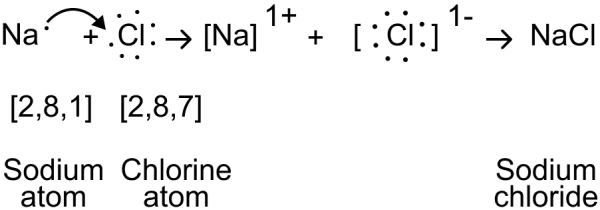
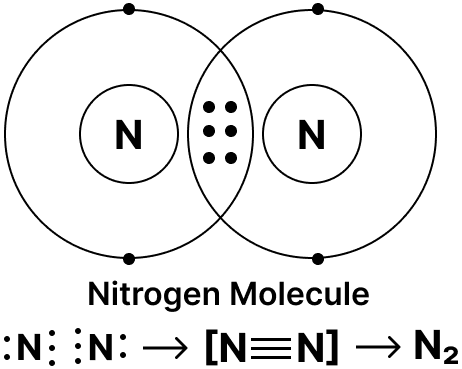
(b) Nitrogen atom (147N) has atomic number 7 and electronic configuration [2, 5]. To attain stable octet structure of the nearest noble gas Neon [2, 8], Nitrogen needs three electrons in the valence shell. Nitrogen atom shares electron pairs with other nitrogen atom resulting in the formation of a molecular or covalent bond as shown below:
Related Questions
Differentiate between the terms —
Stable and unstable electronic configuration
Differentiate between the terms —
Duplet and octet rule.
The nucleus of element with 2 electrons in 'K' shell & 1 electron in 'M' shell.
- is 3919X
- has 12 neutrons
- has 19 protons
- has equal no. protons & neutrons
Which of the following is correct in an element AZY.
- Number of neutrons = Z-A
- Number of protons = A
- Z = sum of protons & electrons
- A = sum of neutrons & electrons