
Biology
Explain the terms ultrafiltration and selective absorption.
Excretory System
34 Likes
Answer
Ultrafiltration — The blood flows through the glomerulus under great pressure which is much greater than in the capillaries elsewhere. The reason for this greater pressure is that the efferent arteriole is narrower than the afferent arteriole. The high pressure causes the liquid part of the blood to filter out from the glomerulus into the renal tubule. This filtration under extraordinary force is called Ultrafiltration.
Selective Absorption —
The glomerular filtrate entering the renal tubule is an extremely dilute solution containing a lot of useful materials such as glucose and some salts such as those of sodium. As this filtrate passes down the renal tubule, a lot of water along with these usable materials is reabsorbed. But their reabsorption is only to the extent that the normal concentration of the blood is not disturbed. This is called Selective Absorption.
Answered By
22 Likes
Related Questions
Given alongside is the figure of certain organs and associated parts in the human body. Study the same and answer the questions that follow:

(a) Name all the organ-systems shown completely or even partially.
(b) Name the parts numbered 1 to 5.
(c) Name the structural and functional unit of the part marked '1'.
(d) Name the two main organic constituents of the fluid that flows down the part labelled '3'.
(e) Name the two major steps involved in the formation of the fluid that passes down the part labelled '3'.
The figure given below represents a kidney tubule in humans and its blood supply. Study the figure and answer the questions that follow. Write specific name and numbers shown in the diagram for each answer.
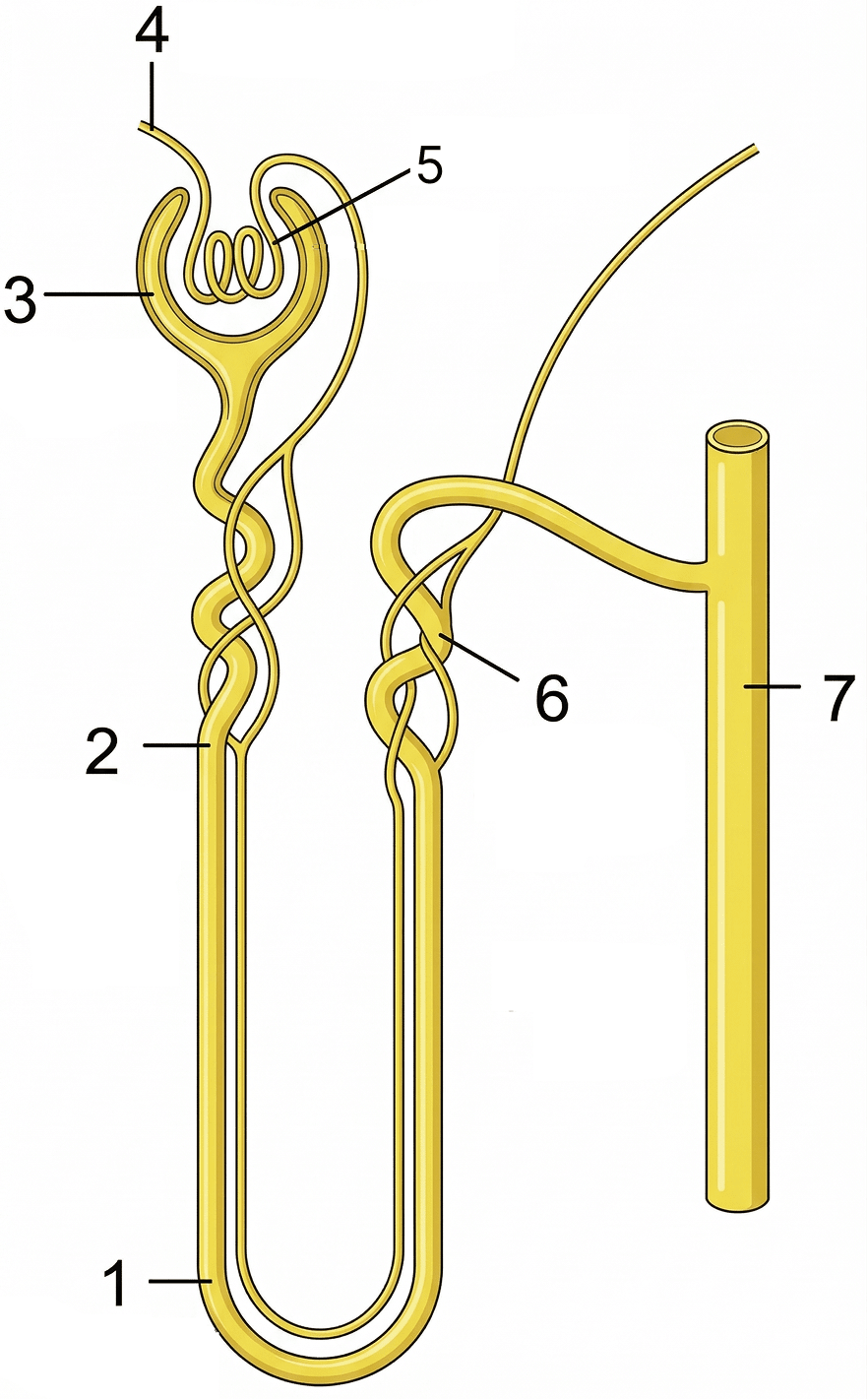
(a) Name the part which consists of a knot-like mass of blood capillaries.
(b) What is the specific name for the combination of parts shown as 5 and 3?
(c) Name the part which collects the glomerular filtrate.
(d) Where is the most water reabsorbed?
(e) Name the part which collects urine in the diagram shown.
(f) Which part lies in the medulla of the kidney?
(g) Which of the above parts is involved in the process of tubular secretion?
(h) How is hydrostatic pressure created?
(i) Where does ultrafiltration take place?
(j) Name two important constituents of urine.
Given alongside is a simplified diagram of the human kidney cut open longitudinally. Answer the questions that follow:
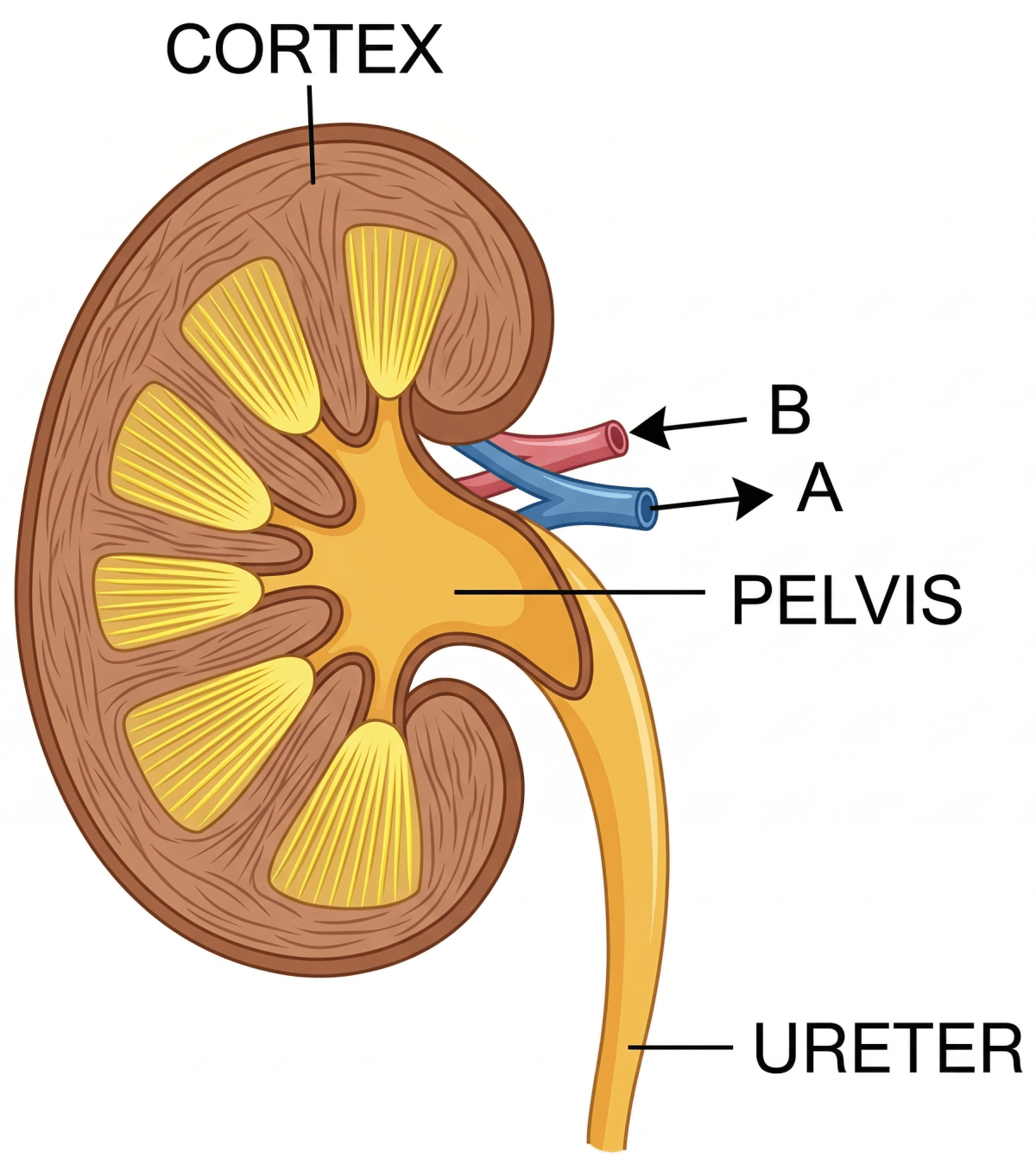
(a) Define excretion.
(b) Why does the cortex of the kidney show a dotted appearance?
(c) Why does the medulla of the kidney show a striped appearance?
(d) Write two differences in composition of the blood flowing through the blood vessels, 'A' and 'B'.
Study the diagram given alongside and then answer the questions that follow:

(a) Name the region in the kidney where the above structure is present?
(b) Name the parts labelled 1, 2, 3, and 4.
(c) Name the stages involved in the formation of urine.
(d) What is the technical term given to the process occurring in 2 and 3? Briefly describe the process.