Chemistry
Explain why a solution of hydrogen chloride in water turns blue litmus red and conducts electricity, while a solution of the same gas in toluene
(i) has no effect on litmus, and
(ii) does not conduct electricity.
Hydrogen Chloride
77 Likes
Answer
A solution of hydrogen chloride in water gives ions,
HCl + H2O ⟶ H3O+ + Cl-
These ions are responsible for conducting electricity and turning blue litmus red, due to the presence of hydronium [H3O+] ions which make aqueous solution of HCl acidic in nature.
Toluene is an organic solvent and HCl is a covalent compound. A solution of HCl in toluene contains only molecules and not ions due to which it does not conduct electricity. The absence of hydronium [H3O+] ions make the solution neutral and it does not effect litmus paper.
Answered By
51 Likes
Related Questions
Study the figure given below and answer the questions that follow :
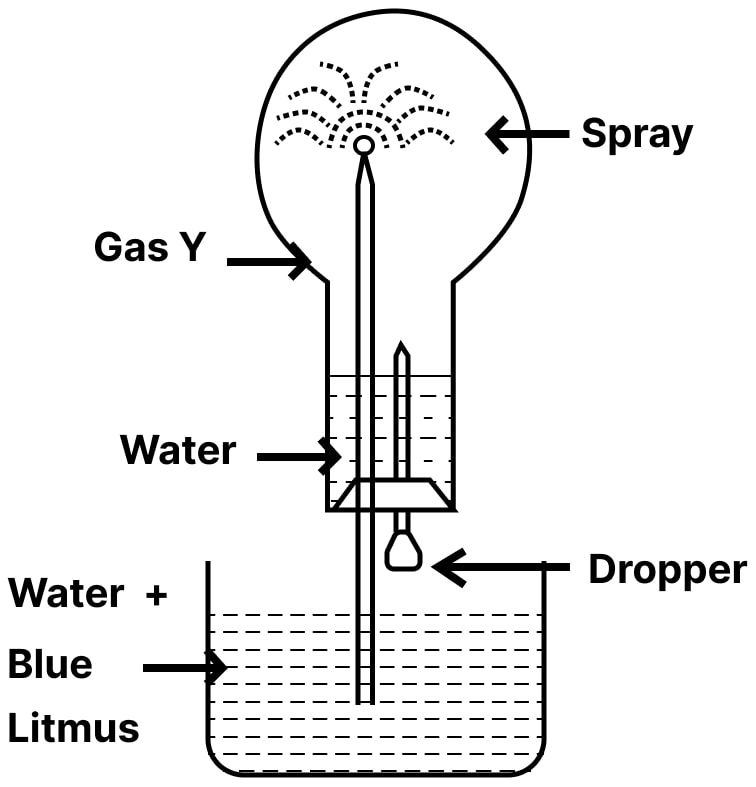
(i) Identify the gas Y.
(ii) What property of gas Y does this experiment demonstrate?
(iii) Name another gas which has the same property and can be demonstrated through this experiment.
Identify the gas evolved and give the chemical test in each of the following cases.
Dilute hydrochloric acid reacts with:
(i) Iron [II] sulphide.
(ii) Sodium sulphite.
State your observations:
(a) HCl gas is passed through lead nitrate solution and the mixture is heated.
(b) Hydrochloric acid is added to silver nitrate solution.
(c) Ammonium hydroxide solution is added to the resultant product of part (b).
Refer to the diagram given below and write balanced equations with conditions, if any, for the following conversions P to S.