Mathematics
The exterior angles B and C in ΔABC are bisected to meet at a point P. Prove that ∠BPC = 90° − . Is ABPC a cyclic quadrilateral ?
Circles
1 Like
Answer
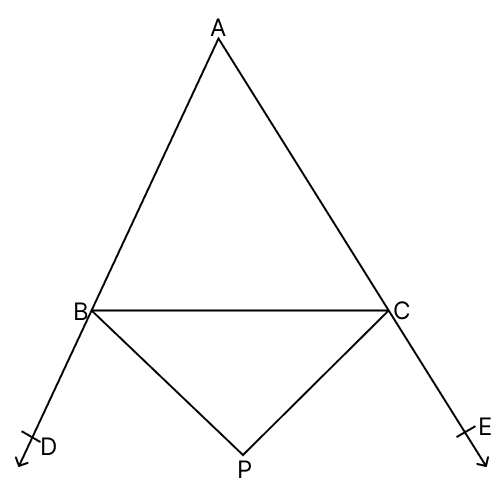
We know that,
An exterior angle of a triangle equals to the sum of the two interior opposite angles.
∠CBD = ∠A + ∠C
∠BCE = ∠A + ∠B.
Since BP bisects the exterior angle ∠CBD :
∠PBC = ∠CBD
Similarly, since CP bisects the exterior angle ∠BCE :
∠PCB = ∠BCE
In △BPC,
By angle sum property of triangle,
For A, B, P, C to be concyclic we would need ∠A + ∠BPC = 180° But:
∵ ∠A + ∠BPC = ∠A +
Hence, proved that and ABPC is not cyclic.
Answered By
1 Like
Related Questions
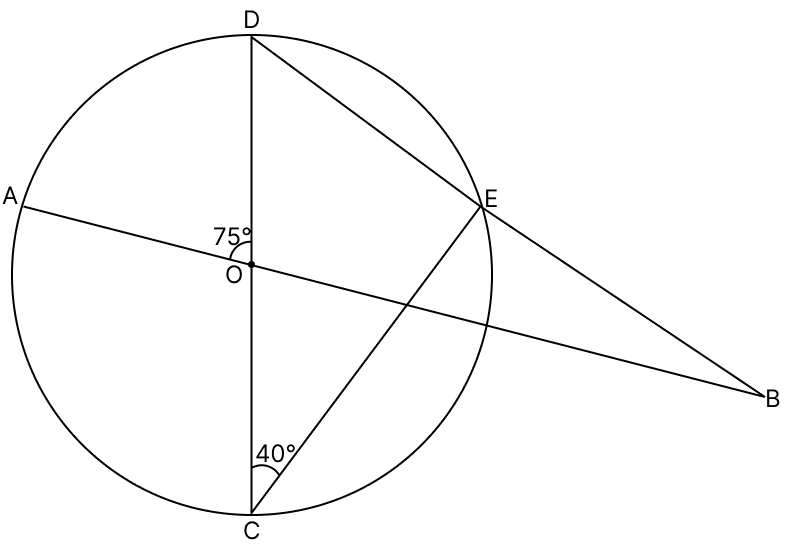
In the given figure, the straight lines AB and CD pass through the centre O of the circle. If ∠AOD = 75° and ∠OCE = 40°, find :
(i) ∠CDE
(ii) ∠OBE.
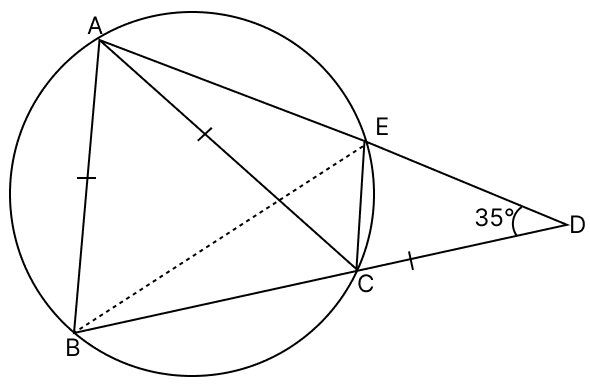
In the adjoining figure, AB = AC = CD and ∠ADC = 35°. Calculate :
(i) ∠ABC
(ii) ∠BEC
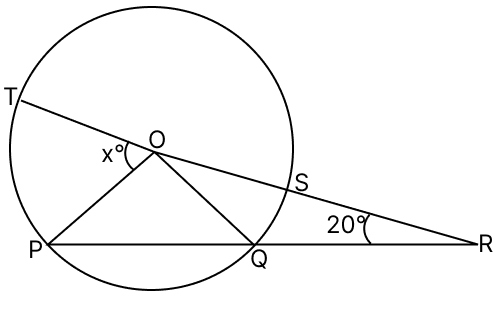
In the given figure, O is the centre of the circle. If QR = OP and ∠ORP = 20°, find the value of x giving reasons.
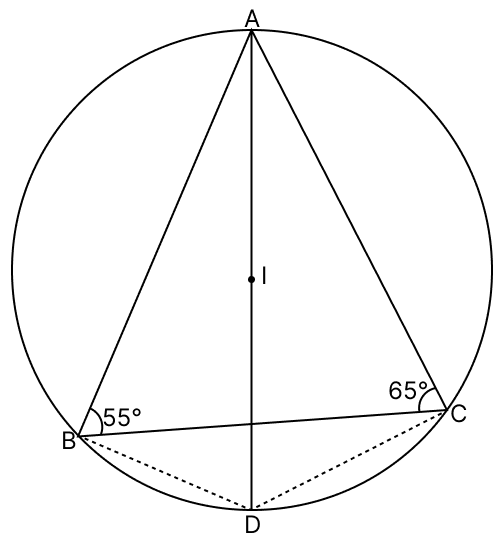
In the given figure, I is the incentre of Δ ABC. Here AI produced meets the circumcircle of Δ ABC at D. If ∠ABC = 55° and ∠ACB = 65°, calculate :
(i) ∠BCD
(ii) ∠CBD
(iii) ∠DCI
(iv) ∠BIC