
Physics
A fast-moving cyclist stops pedalling on reaching a hilly track. If he continues to move with the acquired energy, then assuming no loss of energy:
- his kinetic energy remains constant at all times.
- his potential energy remains constant at all times.
- his total mechanical energy continuously increases.
- his total mechanical energy remains constant.
Work, Energy & Power
5 Likes
Answer
his total mechanical energy remains constant.
Reason — When the cyclist stops pedalling and continues moving on a hilly track, his kinetic energy gradually converts into potential energy as he moves upward. If there is no loss of energy, the sum of kinetic and potential energy remains unchanged.
Therefore, the total mechanical energy remains constant during the motion.
Answered By
1 Like
Related Questions
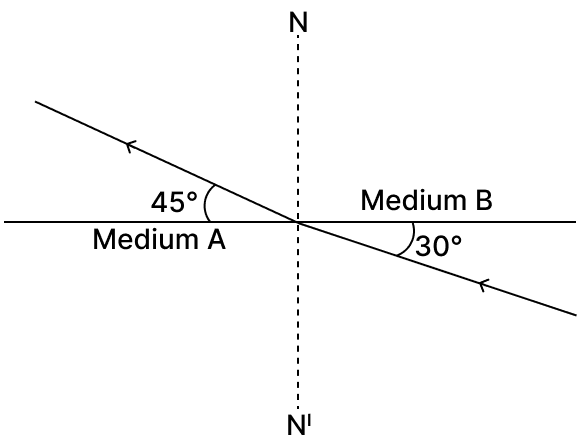
From the figure given below, the refractive index of medium B with respect to medium A (AμB) is:
When a blackened bulb thermometer is moved beyond the red region of the visible spectrum, there is a rapid rise in the temperature. This is due to the presence of :
- Infrared radiations
- Ultraviolet radiations
- X-rays
- Radio waves
The distance (V) of a virtual image formed by a lens of focal length 15 cm never exceeds a certain finite value, then this value will be:
- less than 15 cm
- between 15 cm to 30 cm
- less than or equal equal to 30 cm
- less than or equal to 15 cm
Assertion (A) : Tiny air molecules scatter blue light more than red light.
Reason (R) : The refractive index of a medium is greater for blue light than red light.
- (A) is true but (R) is false.
- (A) is false but (R) is true.
- Both (A) and (R) are true and (R) is correct explanation of (A).
- Both (A) and (R) are true and (R) is not the correct explanation of (A).