
Mathematics
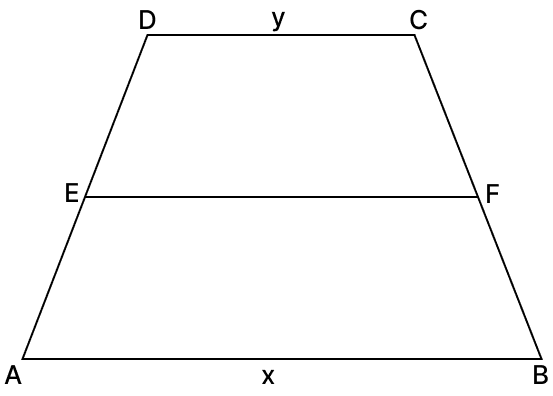
In the figure, ABCD is a trapezium with parallel sides AB = x and CD = y. E and F are mid-points of the non-parallel sides AD and BC respectively. The ratio of ar (ABFE) and ar (EFCD) is :
x : y
(3x + y) : (x + 3y)
(x + 3y) : (3x + y)
(2x + y) : (3x + y)
Theorems on Area
2 Likes
Answer
Join BD which intersects EF at M.
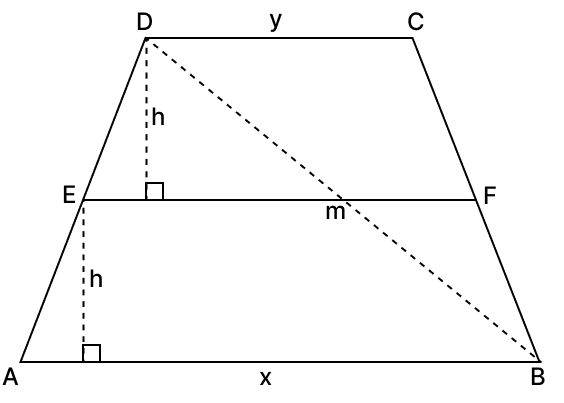
In ∆ABD,
E is the midpoint of AD and EM || AB
By midpoint theorem,
M is the midpoint of BD
EM = ….(1)
In ∆CBD,
F is mid-point of BC and M is mid-point of BD so by mid-point theorem,
MF = ….(2)
So EF ∥ AB and EF ∥ CD
That means:
AB ∥ EF ∥ CD
Adding equations (1) and (2), we get:
EM + MF =
Since:
AB ∥ EF ∥ CD
Let total height between AB and CD = H
EF lies exactly halfway between them,
∴ Height of trapezium EFCD = Height of trapezium ABEF = = h (let)
Area of trapezium =
Area of trapezium ABFE
Area of trapezium EFCD
Required ratio = Area of trapezium ABFE / Area of trapezium EFCD
By substituting the values,
The ratio of ar (ABFE) and ar (EFCD) is (3x + y) : (x + 3y).
Hence, option 2 is the correct option.
Answered By
1 Like
Related Questions
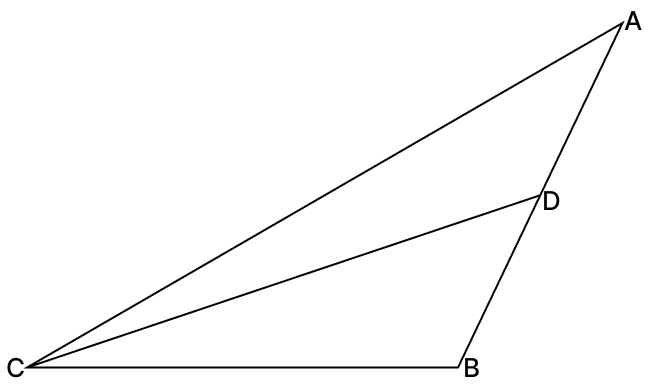
Assertion (A) : In ΔABC, if D is the mid-point of side AB, then area of ΔBCD = area of ΔACD.
Reason (R) : A triangle and a parallelogram on the same base and between the same parallels are equal in area.
A is true, R is false
A is false, R is true
Both A and R are true
Both A and R are false
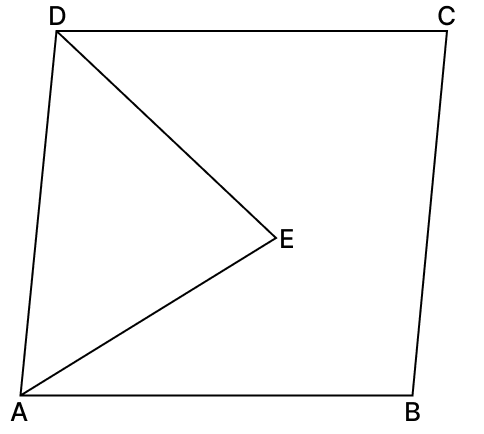
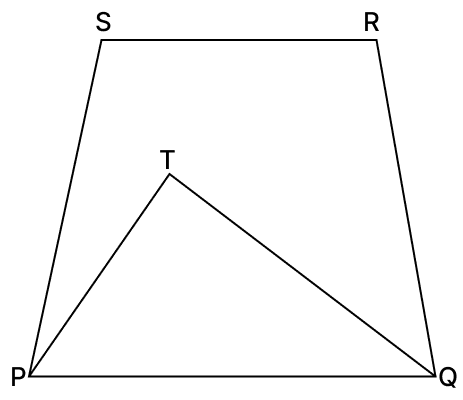
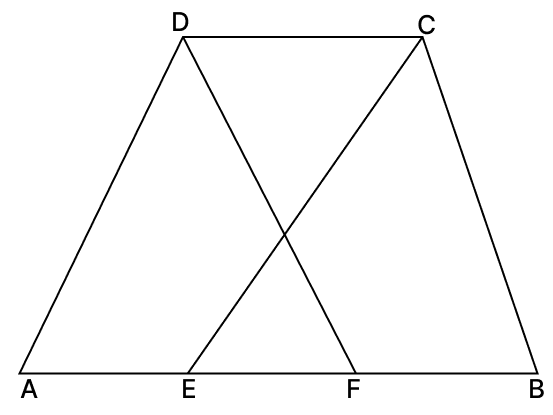
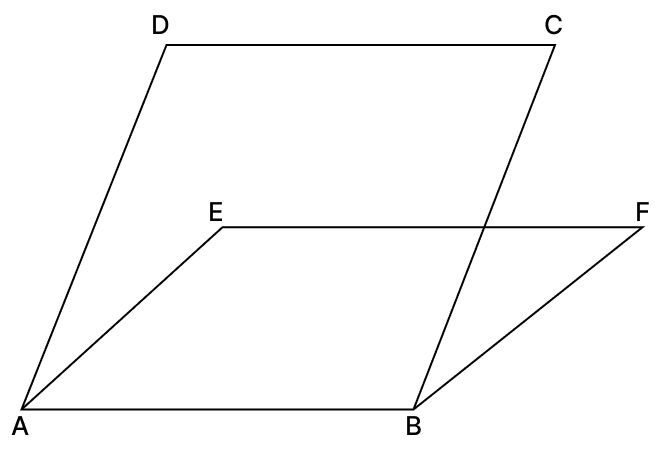
In which of the following, you find two polygons on the same base and between the same parallels?
- 1.
- 2.
- 3.
- 4.
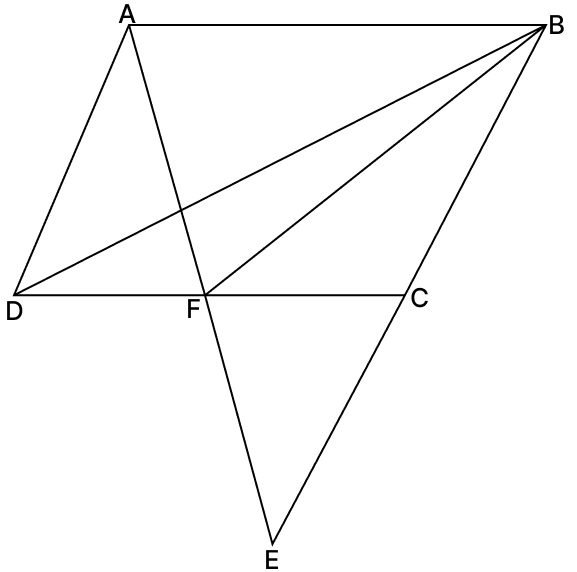
In the figure, ABCD is a parallelogram in which BC is produced to E such that CE = BC. AE intersects CD at F. If area of ΔDFB is 3 cm2, then area of the parallelogram ABCD is :
9 cm2
10 cm2
12 cm2
15 cm2
Bansidhar is a farmer. He has a field in the form of a parallelogram ABCD. He took any point P on CD and joined it to points A and B. In how many parts the field is divided? What are the shapes of these parts? Bansidhar gave the three parts of the field to his two sons equally. How did he do it?