Mathematics
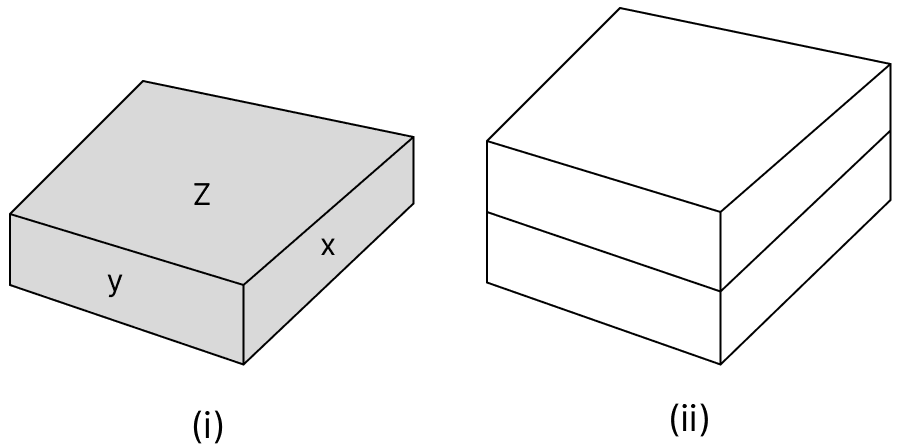
In the figure (i) below, a cuboid is shown. The surface area of three faces are marked as x, y and z. In figure (ii), two such cuboids are stacked. Find the surface area of the new cuboid in figure (ii) in terms of x, y and z.
Mensuration
3 Likes
Answer
Given,
Let the dimensions of the cuboid be :
Length = l
Breadth = b
Height = h
From the figure (i) the three faces have areas:
x = length × height = lh
y = breadth × height = bh
z = length × breadth = lb
When two identical cuboids, are stacked the height is doubled (2h), length (l) and breadth (b) will remain same.
In (ii) figure,
Surface area of top face = length × breadth = lb = z
Surface area of right vertical face = length × height = 2lh = 2x
Surface area of left vertical face = breadth × height = 2bh = 2y
Total surface area = 2x + 2y + z.
Hence, surface area of new cuboid = 2x + 2y + z.
Answered By
2 Likes
Related Questions
If a cube has surface area S and volume V, then the volume of the cube of surface area 2S is :
2V
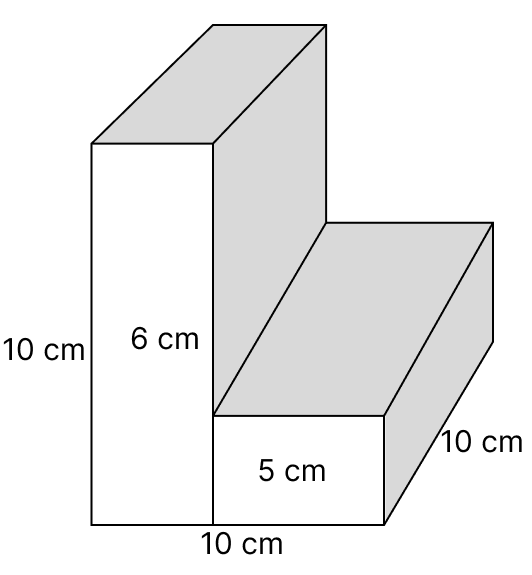
In the figure, four faces of the solid are shaded. The shaded area is :
100 cm2
150 cm2
200 cm2
300 cm2
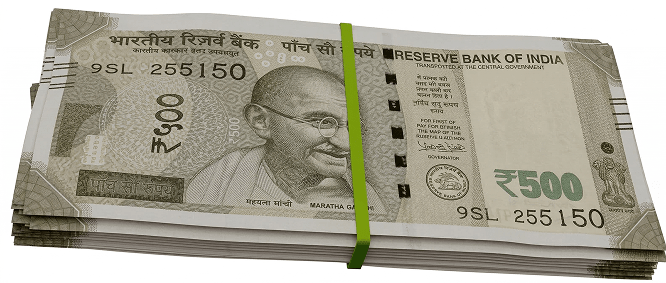
In the figure, there are fifty, 500 rupee notes in the bundle. Volume of the bundle is 98 cm3, length = 14 cm and breadth = 7 cm. The thickness of 1 note is :
1 mm
0.1 mm
2 mm
0.2 mm
A Rubik's cube is made up of several small cubes. Side lengths of each small cube is x. Find the outer surface area of the cube present at one of the corners of the Rubik's cube.