
Biology
The figure given alongside represents the vertical section of a fruit. Study the same and answer the following questions :
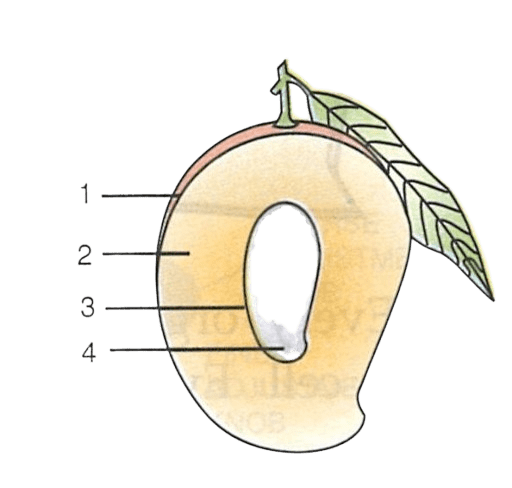
- Identify the fruit and mention whether it is a true fruit or a false fruit.
- Label the guidelines 1, 2, 3 and 4.
- Write the collective name for the parts shown as 1, 2 and 3.
- Name the part of the flower which matures into part 4.
- Which of the above labelled parts of the fruit is fleshy and edible ?
Flower
15 Likes
Answer
The given fruit is Mango. Mango is a true fruit as the fleshy part and the seed both develop from the ovary.
The parts 1 to 4 are:
1 → Epicarp
2 → Mesocarp
3 → Endocarp
4 → SeedEpicarp, Mesocarp, and Endocarp are collectively known as the Pericarp.
The ovule that contains the fertilised cell develops into a seed.
Mesocarp is the sweet, fleshy and edible layer.
Answered By
10 Likes
Related Questions
Give the difference in function between pollen grain and ovule.
Draw a neat diagram of the 'longitudinal section of a maize grain' and label its seven important parts. Answer the following questions :
- Name the structure which divides the embryonic and endospermic region of the grain.
- Among the parts labelled by you above, which one of them is protienaceous in nature ?
- Name the food component which is stored in the endosperm.
- Mention the part of the seed which develops into the root.
- Why do we call it as a 'grain' and not as a seed or fruit ?
Given alongside is a figure of the vertical section of a typical bisexual flower. Study the same and answer the following questions :
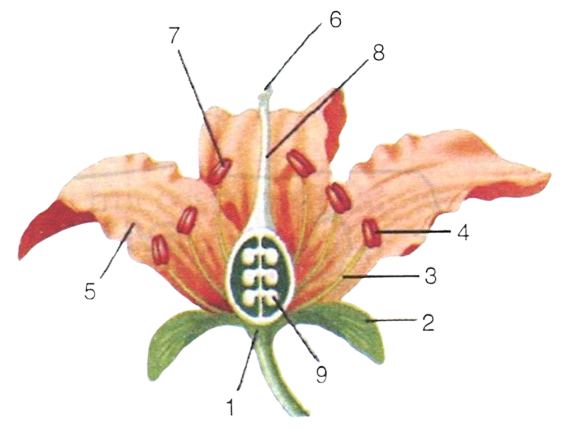
- Label the guidelines 1 to 9.
- Which of the above labelled parts constitute the pistil? Write the numbers and names of those parts.
- Name the part which produces pollen grains.
- Is it a complete/incomplete flower ? Give reason in support of your answer.
- Write one important role of the part labelled as 6.
One winter morning, Shweta and her mother were sitting in their garden when they noticed fresh pea flowers blooming. Over the next few days, they watched some of these flowers slowly develop into tiny green pea pods. Together, they began tracking each stage of this change and observed how pollination and fertilization occur in plants. Answer the following questions:
(i) What role do insects play in the development of a flower into a fruit?
(ii) Mention the male and female gametes of the flower.
(iii) What is the function of the pollen tube during fertilization?
(iv) What happens to the ovary once fertilization is completed?
(v) Shweta's mother claimed that the pea pod is a fruit and not a vegetable. Explain.