
Physics
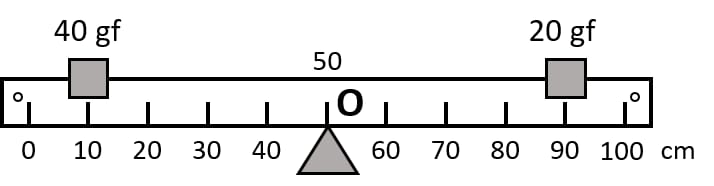
Figure shows a uniform metre rule placed on a fulcrum at its mid-point O and having a weight 40gf at the 10 cm mark and a weight of 20 gf at the 90 cm mark.
(i) Is the metre rule in equilibrium? If not, how will the rule turn?
(ii) How can the rule be brought in equilibrium by using an additional weight of 40gf?
Force
328 Likes
Answer
(i) We know that when anticlockwise moment is equal to clockwise moment then the rule will be in equilibrium.
Let us check,
(a) Anticlockwise moment = Fr
Clockwise moment = Fr
So, the meter rule will not be in equilibrium. It will turn in anticlockwise direction.
(ii) To balance the rule in equilibrium 40gf should be kept on right side.
Let distance from middle = d cm
So clockwise moment becomes
As we know, the principle of moments states that
Anticlockwise moment = Clockwise moment
Therefore,
∴ Distance from 0 cm mark = 50 cm + 20 cm = 70 cm
So, the additional weight should be placed at 70cm mark to bring the rule in equilibrium.
Answered By
207 Likes
Related Questions
An aluminium rod of length 50 cm whose mass per unit length is 0.15 kg/m is joined with a steel rod of length 50 cm whose mass per unit length is 0.45 kg/m as shown in the figure below.
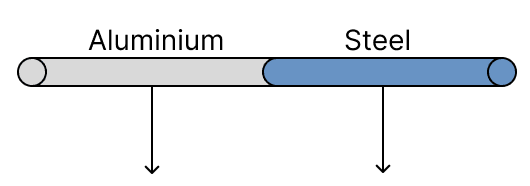
At what point should the rod be supported so that it remains in equilibrium horizontally?
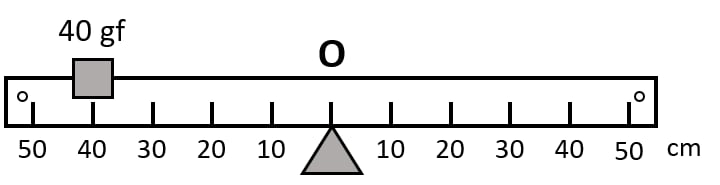
The diagram shows a uniform bar supported at the middle point O. A weight of 40 gf is placed at a distance 40cm to the left of the point O. How can you balance the bar with a weight of 80 gf?
When a boy weighing 20 kgf sits at one end of a 4m long see-saw, it gets depressed at its end. How can it be brought to the horizontal position by a man weighing 40 kgf.
A physical balance has its arms of length 60 cm and 40 cm. What weight kept on a pan of longer arm will balance an object of weight 100 gf kept on other pan?