
Mathematics
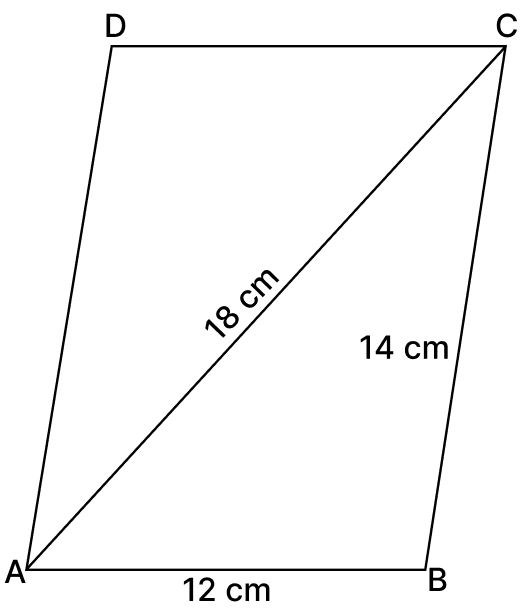
Find the area of parallelogram, if its two adjacent sides are 12 cm and 14 cm, and if the diagonal connecting their ends is 18 cm.
Mensuration
1 Like
Answer
By formula,
Area of triangle =
In triangle ABC,
Let, AB = a = 12 cm, BC = b = 14 cm, AC = c = 18 cm
s = = 22 cm.
Substituting values we get :
A diagonal of //gm divides it into triangles of equal area.
Thus, Area of //gm ABCD = 2.Area of triangle ABC
= 2 × 83.9
= 167.80 cm2.
Hence, area of parallelogram = 167.80 cm2.
Answered By
1 Like
Related Questions
A rectangular courtyard 3.78 m long and 5.25 m broad is to be paved exactly with square tiles, all of the same size. What is the largest size of such a tile? Also, find the number of tiles.
The cost of cultivating a square field at the rate of ₹ 160 per hectare is ₹ 1,440. Find the cost of putting a fence around it at the rate of 75 paise per metre.
Find the length of a diagonal of a square of area 200 cm2.
The area of a square field is 8 hectare. How long would a man take to cross it diagonally by walking at the rate of 4 kmph?