Mathematics
Find the area of a quadrilateral one of whose diagonals is 25 cm and the lengths of perpendiculars from the other two vertices are 16.4 cm and 11.6 cm respectively.
Mensuration
1 Like
Answer
A quadrilateral ABCD is shown in the figure below :
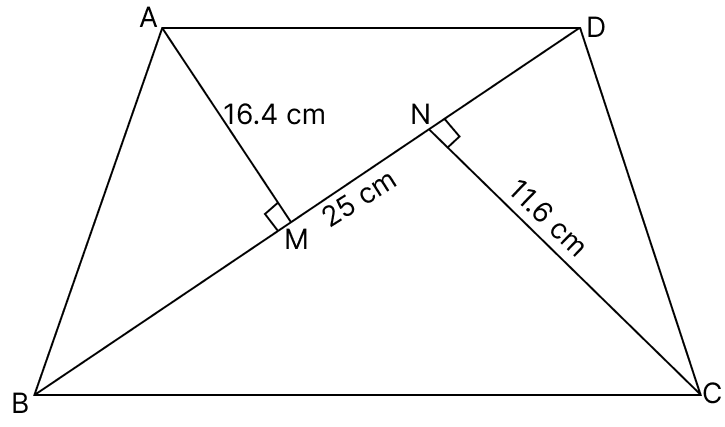
AM and CN are the perpendiculars from A and C respectively to the diagonal BD.
Area of triangle = × base × height
For △ABD,
Area = × BD × AM
= × 25 × 16.4
= 25 × 8.2
= 205 cm2.
For △CBD,
Area = × BD × CN
= × 25 × 11.6
= 25 × 5.8
= 145 cm2.
Area of quadrilateral ABCD = Area of triangle ABD + Area of triangle CBD
= 205 + 145
= 350 cm2.
Hence, area of quadrilateral = 350 cm2.
Answered By
2 Likes
Related Questions
The altitude drawn to the base of an isosceles triangle is 8 cm and the perimeter is 32 cm. Find the area of the triangle.
The area of a triangle is 216 cm2 and its sides are in the ratio 3 : 4 : 5. Find the perimeter of the triangle.
The diagonals of a quadrilateral intersect each other at right angles. If the lengths of these diagonals be 14 cm and 19 cm respectively, find the area of the quadrilateral.
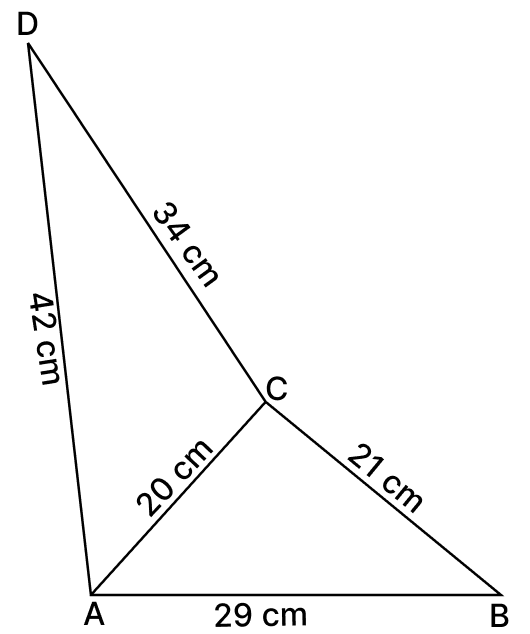
Find the area of quadrilateral ABCD in which AB = 29 cm, BC = 21 cm, AC = 20 cm, CD = 34 cm and DA = 42 cm.