
Mathematics
Find the area of a rhombus one side of which measures 20 cm and the one of whose diagonals is 24 cm.
Mensuration
2 Likes
Answer
ABCD is a rhombus with diagonals BD and AC.
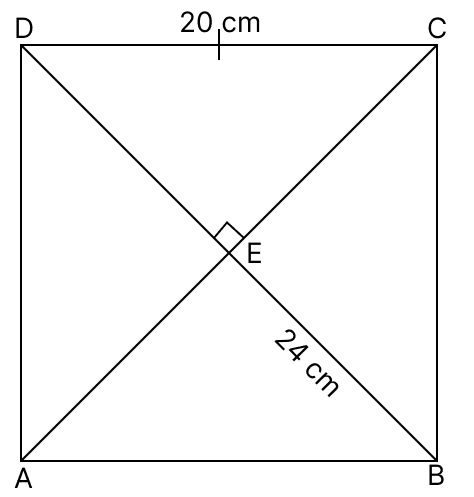
DC = 20 cm
BD = 24 cm
Diagonals of a rhombus bisect each other at 90°.
DE = = 12 cm.
In a right triangle DEC,
Hypotenuse (DC) = 20 cm
DE = 12 cm.
By using pythagoras theorem for the right triangle DEC,
⇒ DC2 = DE 2 + EC2
⇒ 202 = 122 + EC2
⇒ EC2 = 202 - 122
⇒ EC2 = 400 - 144
⇒ EC2 = 256
⇒ EC =
⇒ EC = 16 cm.
AC = 2 × EC
= 2 × 16 = 32 cm.
Area of rhombus = × (product of diagonals)
= × 24 × 32
= 12 × 32
= 384 cm2.
Hence, area of rhombus = 384 cm2.
Answered By
1 Like
Related Questions
Find the area and perimeter of a square plot of land whose diagonal is 15 m. Give your answer correct to two decimal places.
The area of a parallelogram is 338 m2. If its altitude is twice the corresponding base, determine the base and the altitude.
The two parallel sides of a trapezium are 58 m and 42 m long. The other two sides are equal, each being 17 m. Find its area.
The perimeter of a rhombus is 52 cm. If one of its diagonals is 24 cm long, find:
(i) the length of the other diagonal,
(ii) the area of the rhombus.