Mathematics
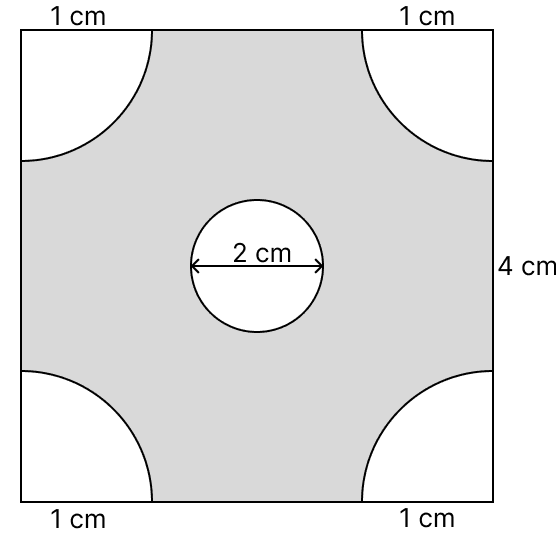
Find the perimeter and area of the shaded region shown in the figure. The four corners are circle quadrants and at the centre, there is a circle.
Mensuration
1 Like
Answer
4 quadrants = 1 full circle
Circumference of circle = 2πr
= 2 × 3.14 × 1
= 6.28 cm.
Length of each shaded straight sides = 4 - 1 - 1 = 2 cm.
Total length = 4 × 2 = 8 cm.
Central circle boundary :
radius = = 1 cm.
Circumference of circle = 2πr
= 2 × 3.14 × 1
= 6.28 cm.
Total perimeter = 6.28 + 8 + 6.28 = 20.56 cm.
Area of shaded region = Area of the square - (Area removed at the corners - Area of central circle)
Area of square = (side)2 = 42 = 16 cm2.
Area removed at the corners :
Area of 1 quadrant = πr2
= × 3.14 × 12 = 0.785
∴ For 4 quadrants = 4 × 0.785 = 3.14 cm2.
Area of central circle = πr2
= 3.14 × 12 = 3.14 cm2.
Area of shaded region = Area of square - Area of central circle - Area of 4 quadrants
= 4 × 4 - (3.14 + 3.14)
= 16 - 6.28 = 9.72 cm2.
Hence, perimeter = 20.56 cm and area of shaded region = 9.72 cm2.
Answered By
2 Likes
Related Questions
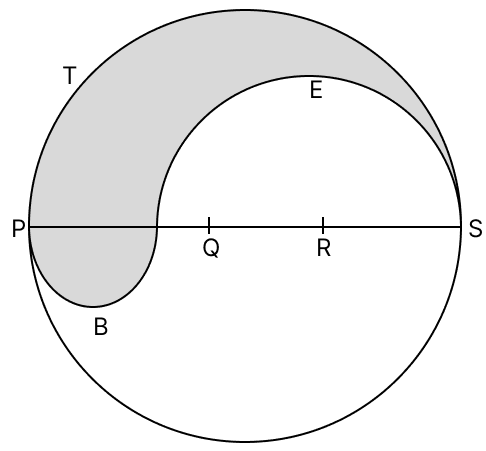
In the given figure, PQRS is a diameter of a circle of radius 6 cm. The lengths PQ, QR and RS are equal. Semi-circles are drawn on PQ and QS as diameters. If PS = 12 cm, find the perimeter and the area of the shaded region.
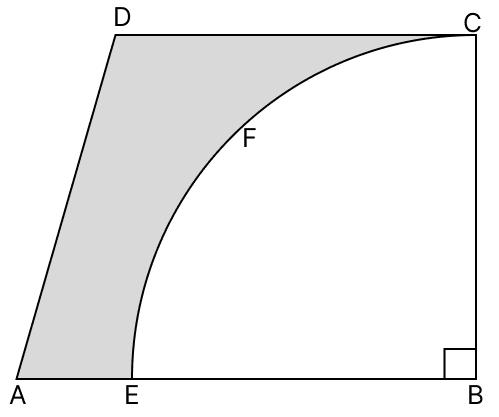
In the given figure, ABCD is a piece of cardboard in the shape of trapezium in which AB || DC, ∠ABC = 90°. From this piece, quarter circle BEFC is removed. Given DC = BC = 4.2 cm and AE = 2 cm. Calculate the area of the remaining piece of the cardboard.
Find the perimeter and area of the shaded region in the given figure.
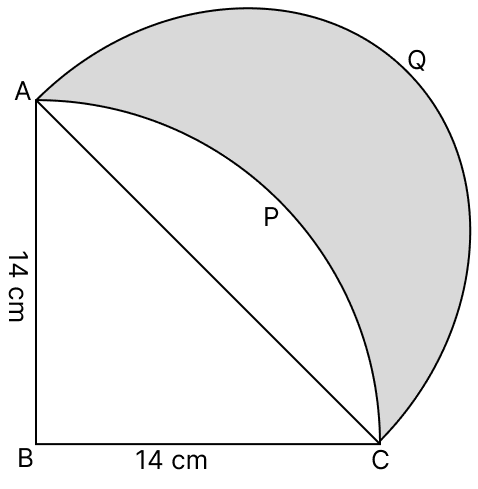
In the given figure, ABCP is a quadrant of a circle of radius 14 cm. With AC as diameter, a semi-circle is drawn. Find the area of shaded region.