
Physics
Which of the following figures will depict deviation of a ray of light through 90° when it emerges out of the prism.
- 1.
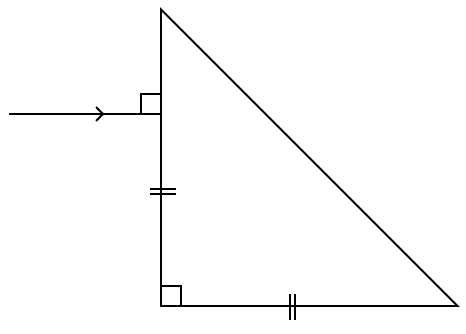
- 2.
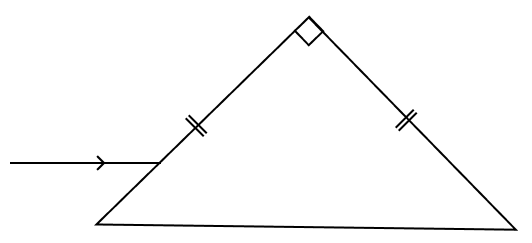
- 3.
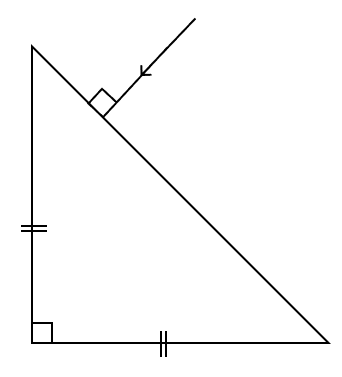
- 4.
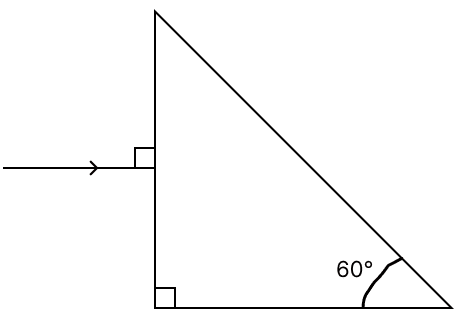
Refraction Plane Surfaces
11 Likes
Answer
option (1)
Reason — When light passes through a right-angled isosceles prism, and is incident perpendicularly on one of its sides, it can undergo total internal reflection (TIR) at the hypotenuse and finally emerge at 90° from the original direction.
Such a situation occurs when :
- The light enters one perpendicular face,
- Reflects off the hypotenuse (TIR at 45°), and
- emerges from the other perpendicular face, making a 90° turn overall.
So, a prism satisfying above conditions will definitely produce a ray deviated by 90°.
Now,
In option (1)
- Isosceles Right-angled triangle.
- Light enters perpendicularly to one of the perpendicular sides.
- Will reflect off the hypotenuse and exit from the other perpendicular side as shown in below figure.
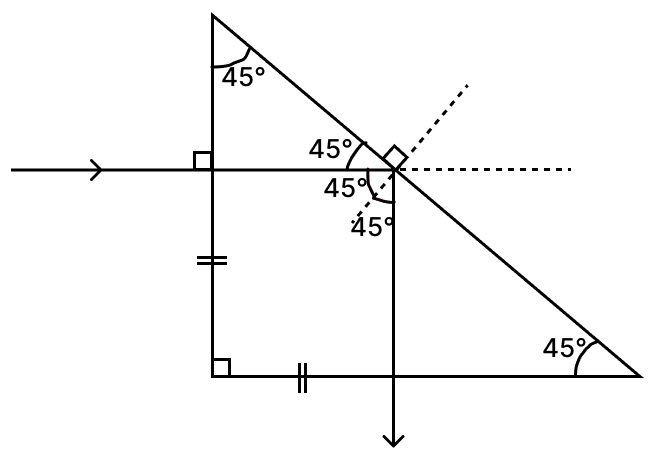
Hence, it deviates the incident ray by 90°.
In option (2)
- Isosceles triangle with the vertex angle at the top being 90°.
- Light enters symmetrically from one side.
- Due to symmetry, this setup generally leads to no net deviation as shown in below figure.
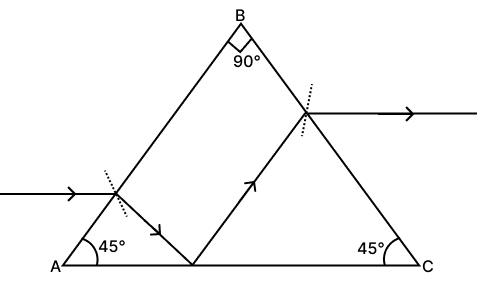
Hence, it can not deviate the incident ray by 90°.
In option (3)
- Isosceles Right-angled triangle.
- Ray enters at the hypotenuse, perpendicularly.
- Emerges from the hypotenuse again and deviates the ray by 180° as shown in below figure.
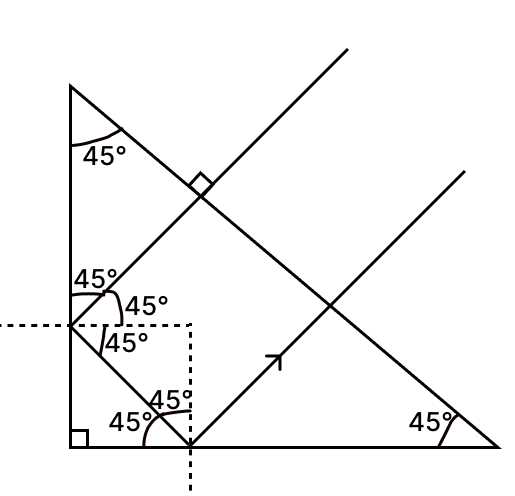
Hence, it can not deviate the incident ray by 90°.
In option (4)
- Triangle with 60°, 90°, and 30° angles.
- Light enters at the face opposite 60°.
- Not a right-angled isosceles prism.
- Path will not lead to 90° deviation as shown in below figure.
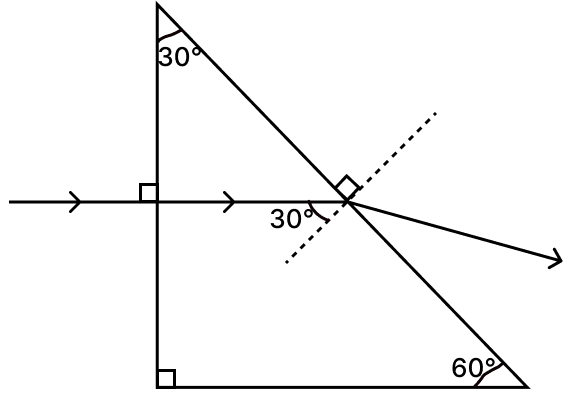
Hence, it can not deviate the incident ray by 90°.
Answered By
6 Likes
Related Questions
10 eV is …………… .
- 1.6 x 10⁻¹⁸ J
- 1.6 x 10⁻¹⁹ J
- 6.25 x 10¹⁹ J
- 6.25 x 10¹⁸ J
A crowbar of length 1.0 m has its fulcrum at a distance of 0.2 m from the load. The mechanical advantage of the crowbar is:
- 5
- 4
- 3
- 2
Which of the following values can represent the magnification of a simple microscope?
- +1
- –1
- +2
- –2
An object placed at a distance 30 cm in front of a lens produces clear inverted image at a distance 60 cm from the lens. If the object is placed at 60 cm from the lens, then it produces a clear inverted image at a distance of …………… from the lens.
- 20 cm
- 30 cm
- 60 cm
- 90 cm