
Chemistry
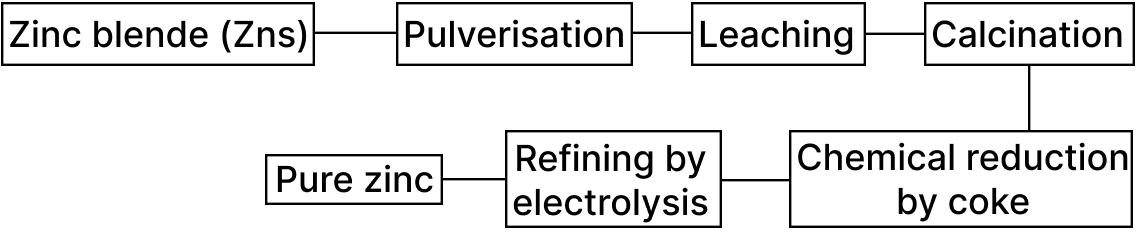
The following flow chart shows the process of extraction of zinc. Out of the 5 steps, 2 steps are incorrect. Identify and correct them.
Metallurgy
2 Likes
Answer
| Step | Process in Chart | Status | Correct Process |
|---|---|---|---|
| 1 | Pulverisation | Correct | Pulverisation |
| 2 | Leaching | Incorrect | Froth Floatation |
| 3 | Calcination | Incorrect | Roasting |
| 4 | Reduction by Coke | Correct | Reduction by Coke |
| 5 | Refining by Electrolysis | Correct | Refining by Electrolysis |
1st Incorrect Step: Leaching
Correction: Froth Floatation
Reason: Zinc blende is a sulphide ore. Sulphide ores are preferentially wetted by oil and are concentrated using the Froth Floatation process rather than leaching.
2nd Incorrect Step: Calcination
Correction: Roasting
Reason: Calcination is used for carbonate ores (heating in the absence of air). Since Zinc blende is a sulphide ore, it must be heated strongly in the presence of excess air to convert it into zinc oxide (ZnO). This process is called Roasting.
Answered By
1 Like
Related Questions
(a) Some metallic oxides can be reduced by hydrogen, carbon, carbon monoxide and some cannot. Explain.
(b) Write balanced equation for the reduction of copper (II) oxide by hydrogen.
An ore on being heated in air forms sulphurous anhydride. Write the process used for the concentration of this ore.
State why aluminium is extracted from it's oxide by electrolysis while copper, lead, iron by reducing agents and mercury and silver by thermal decomposition.
How are the metals like sodium, potassium and calcium obtained. Give equations.