
Mathematics
The following table shows the relationship between the monthly incomes and the number of vehicles in a family. If 2000 families, in a locality, are selected, the information gathered is listed in the table below :
| Monthly income (₹) | 0 vehicle | 1 vehicle | 2 or more than 2 vehicles |
|---|---|---|---|
| Less than 10,000 | 1 | 140 | 13 |
| 10,000 - 12,000 | 2 | 285 | 17 |
| 12,000 - 14,000 | 0 | 515 | 0 |
| 14,000 - 16,000 | 0 | 449 | 9 |
| 16,000 or more | 3 | 559 | 7 |
A family is chosen, write the probability that the family chosen is :
(i) earning ₹ 10,000 - ₹ 12,000 per month and owning exactly 1 (one) vehicle.
(ii) earning ₹ 14,000 or more per month and owning 2 or more than 2 vehicles.
(iii) not owning more than 1 vehicle.
Probability
1 Like
Answer
Total number of families = 2000.
By formula,
Probability of an event =
(i) Number of families earning ₹ 10,000 - ₹ 12,000 per month and owning exactly 1 vehicle = 285.
∴ Required probability = .
Hence, the required probability = .
(ii) Number of families earning ₹ 14,000 or more per month and owning 2 or more vehicles = 9 + 7 = 16.
∴ Required probability = .
Hence, the required probability = .
(iii) Families not owning more than 1 vehicle are those owning 0 or 1 vehicle.
Number of such families = (1 + 2 + 0 + 0 + 3) + (140 + 285 + 515 + 449 + 559)
= 6 + 1948 = 1954.
∴ Required probability = .
Hence, the required probability = .
Answered By
1 Like
Related Questions
A die is thrown 300 times and outcomes are noted as given below :
Outcomes 1 2 3 4 5 6 Frequency 50 73 55 44 45 33 When the same die is thrown once more, what is the probability of getting :
(i) 4 ?
(ii) 6 ?
(iii) 5 ?
(iv) 2 ?
The percentage of marks obtained by a student of class X in four unit tests are given below :
Unit test I II III IV Marks secured % 62 69 33 86 A test is selected at random. What is the probability that the student gets 69% marks in the test ?
A square dartboard has sections numbered from 1 to 12 as shown below. Players have to make a prediction and throw a dart. They win if their dart lands on the section that matches their prediction. Three friends Amit, Aryan and Aman took the challenge.
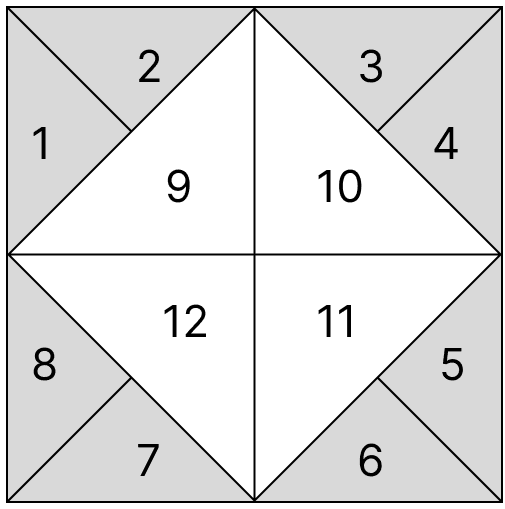
Based on the above information, answer the following :
(i) What is the probability of Amit winning if he predicted that his dart will land on a prime number ?
(ii) What is the probability of Aryan winning if he predicted that his dart will land on an odd number ?
(iii) What is the probability of Aman winning if he predicted that his dart will land on a square number ?
(iv) Which of the three friends has the highest chance of winning ?
A teacher conducted a survey for 180 students of class 10 for a mathematics project to be given in the class.
She asked the students two MCQ questions, which were "What is their favourite subject ?" and "What time do they use their mobile phone at night ?". Each student could choose only one option from the choices given below.
The following are the results of the survey conducted :
Mobile phone use Mathematics Science Computer English Before 9 pm 20 12 8 4 9 pm - 10 pm 13 15 5 8 10 pm - 11 pm 15 18 6 10 After 11 pm 22 10 6 8 Based on the above information, answer the following questions :
(i) If a student is selected at random, what is the probability that the student uses mobile phone after 11 pm and that their favourite subject is Mathematics ?
(ii) If a student is selected at random, what is the probability that the student uses mobile phone after 10 pm ?
(iii) If a student is selected at random, what is the probability that their favourite subject is Science ?
(iv) If a student is selected at random, what is the probability that the student uses mobile phone before 10 pm and that their favourite subject is either Mathematics or Computer ?