
Mathematics
For the three circles with centers A, B and C and radii 5 cm, 2 cm and 6 cm respectively.
Assertion (A) : To find the perimeter of the triangle ABC, add the radii of given three circles.
Reason (R) : The required perimeter is the product of sum of radii by 2.
A is true, R is true
A is true, R is false
A is false, R is true
A is false, R is false
Circles
12 Likes
Answer
Let the circles intersect at points D, E and F.

From figure,
Perimeter of triangle ABC = AB + BC + CA
= (AD + BD) + (BE + CE) + (CF + FA)
= 5 + 2 + 2 + 6 + 6 + 5
= 26 cm.
On adding radii of three circles, we get :
5 + 2 + 6 = 13 cm, which is not equal to perimeter.
Sum of radii × 2 = 13 × 2 = 26 cm, which is equal to perimeter.
∴ A is false, R is true
Hence, Option 3 is correct option.
Answered By
4 Likes
Related Questions
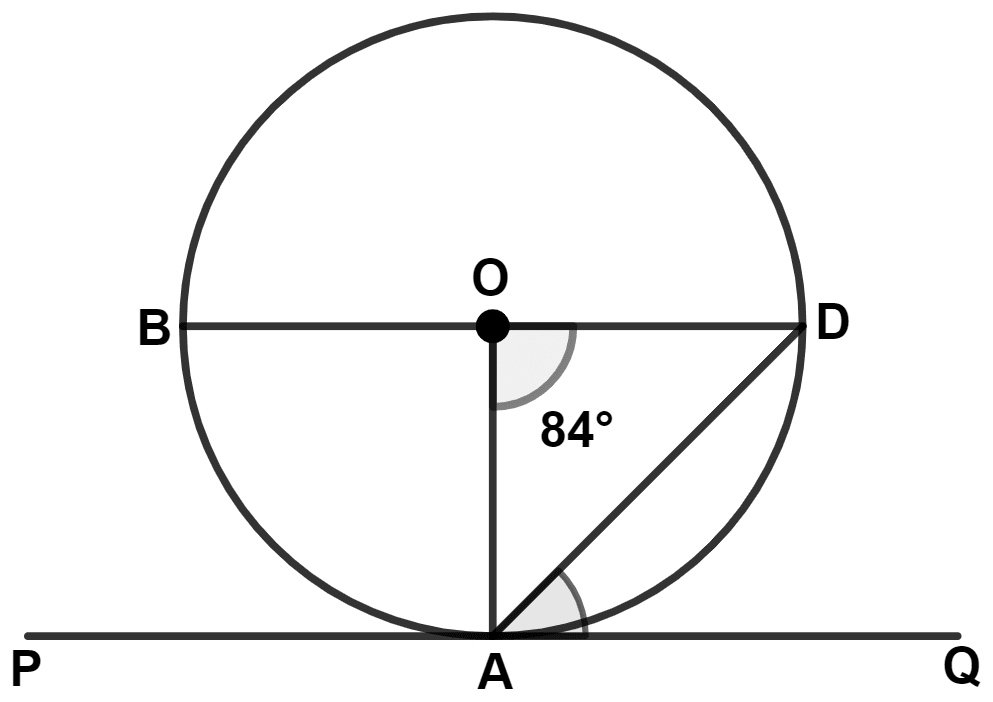
In the given figure O is center, PQ is tangent at point A. BD is diameter and ∠AOD = 84° then angle QAD is :
32°
84°
48°
42°
Two mutually perpendicular tangents are drawn to a circle with radius units. The shortest distance between the two points of contact is :
R units
units
units
2R units
AB is diameter of the circle. PA is tangent and ∠AOC = 60°.
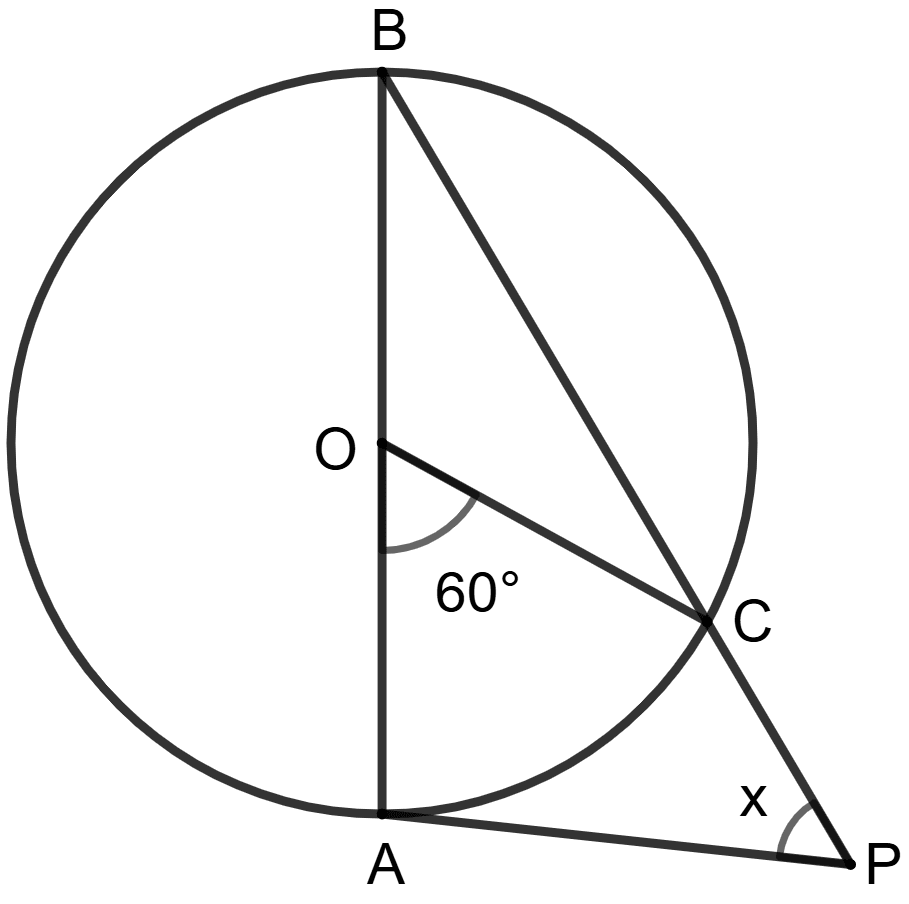
Assertion(A): x + 30° = 90°.
Reason(R): PA is tangent
⇒ ∠BAP = 90°
∴ x + 30° = 90°
A is true, R is false.
A is false, R is true.
Both A and R are true and R is correct reason for A.
Both A and R are true and R is incorrect reason for A.
Chords AD and BC one produce meet at exterior point P.
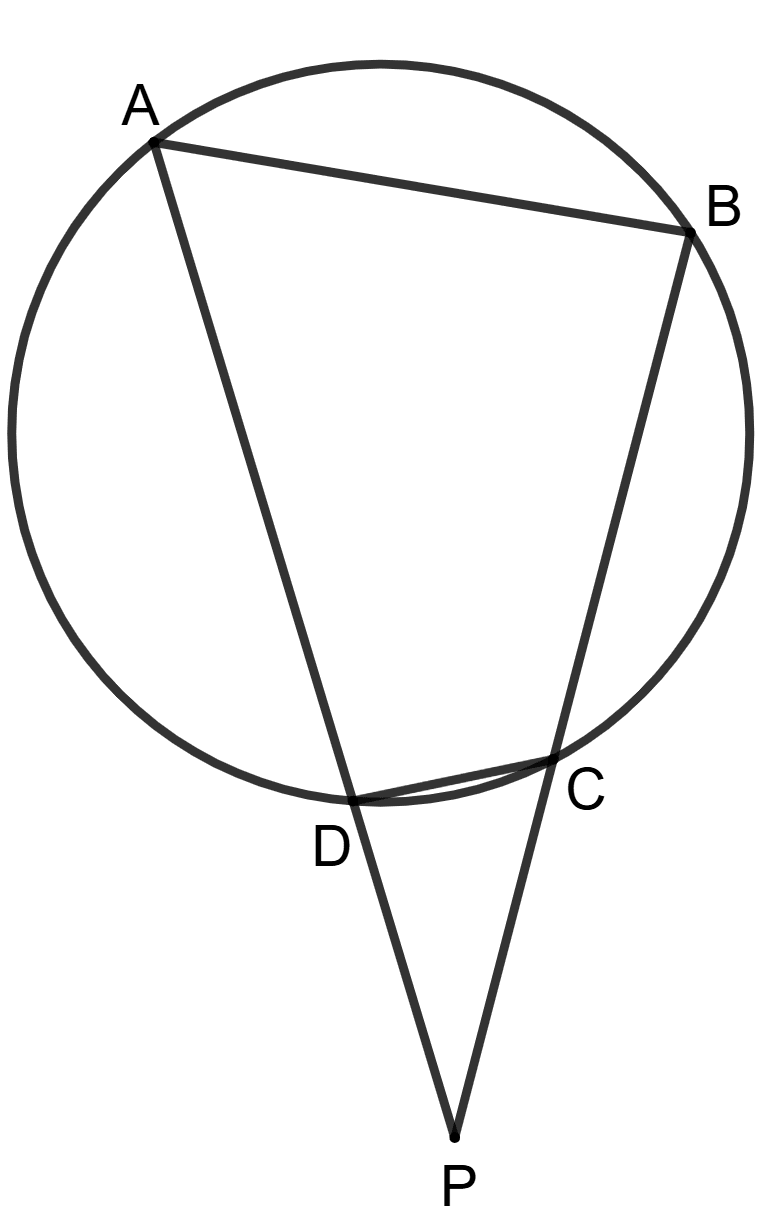
Assertion(A): PD x AD = PC x BC.
Reason(R): In triangles PAB and PCD.
∠PAB = ∠PCD ⇒ ΔPAB ∼ ΔPCD
A is true, R is false.
A is false, R is true.
Both A and R are true and R is correct reason for A.
Both A and R are true and R is incorrect reason for A.