
Mathematics
Gautam had two sticks of equal length. He named them AB and CD. He then placed these two sticks in three different ways and joined their four vertices as shown below.
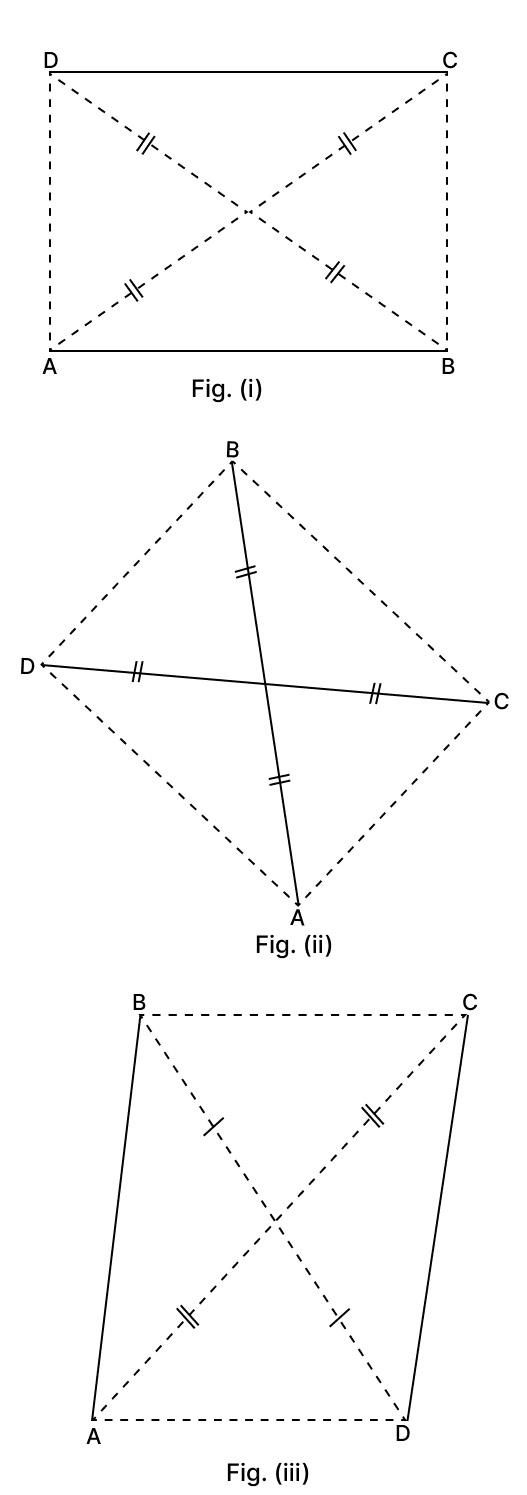
(i) What type of quadrilateral is in :
(a) Fig (i) ?
(b) Fig (ii) ?
(c) Fig (iii) ?
(ii) What is the sum of consecutive angles in Fig (iii) ?
(iii) If ∠BAD = 70° in Fig (iii), then what is the measure of ∠CDA ?
Rectilinear Figures
1 Like
Answer
(i)
(a) In figure (i),
One pair of opposite sides are equal in length (AB = CD).
The diagonals are equal and they bisect each other.
If one pair of opposite sides of a quadrilateral are equal, and its diagonals are equal and bisect each other, the quadrilateral is a rectangle.
Hence, the quadrilateral in figure (i) is a rectangle.
(b) In figure (ii),
The diagonals of quadrilateral are equal and bisect each other. (AB = CD)
If the diagonals of a quadrilateral are equal and bisect each other, then the quadrilateral is a rectangle.
Hence, the quadrilateral in figure (ii) is a rectangle.
(c) In figure (iii),
Sides AB and CD are equal and parallel.
The diagonals of quadrilateral bisect each other.
Since, one pair of sides are equal and parallel and diagonals bisect each other, thus the quadrilateral is a parallelogram.
Hence, the quadrilateral in figure (iii) is a parallelogram.
(ii) In a parallelogram, sum of consecutive angles is equal to 180°.
Hence, the sum of consecutive angles in figure (iii) is 180°.
(iii) Sum of adjacent angles in a parallelogram is 180°.
Thus, in figure (iii),
⇒ ∠BAD + ∠CDA = 180°
⇒ 70° + ∠CDA = 180°
⇒ ∠CDA = 180° - 70° = 110°.
Hence, ∠CDA = 110°.
Answered By
3 Likes
Related Questions
In the following figure, ABCD is a rhombus and DCFE is a square.
If ∠ABC = 56°, find :
(i) ∠DAE
(ii) ∠FEA
(iii) ∠EAC
(iv) ∠AEC

In parallelogram ABCD, E is the mid-point of side AB and CE bisects angle BCD. Prove that :
(i) AE = AD
(ii) DE bisects angle ADC
(iii) angle DEC is a right angle
In parallelogram ABCD, X and Y are mid-points of opposite sides AB and DC respectively. Prove that :
(i) AX = YC
(ii) AX is parallel to YC
(iii) AXCY is a parallelogram
Prashant had a plot of land in the shape of a quadrilateral. He constructed his house in the middle by joining the mid-points of the four sides of the land and used the remaining four portions at the four ends for different purposes, like a small garden, swimming pool, etc.
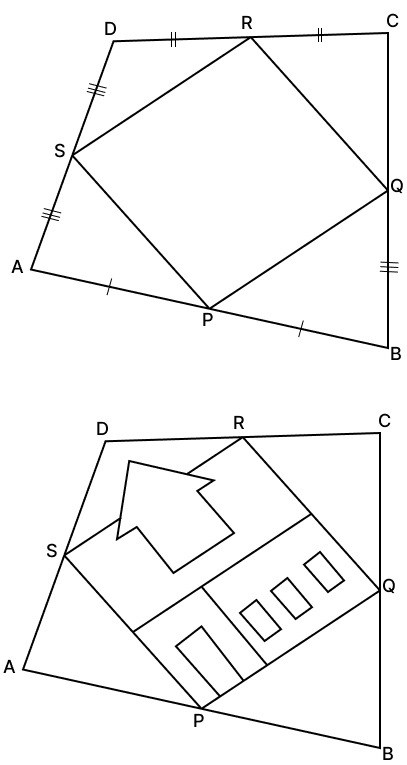
(i) What type of a quadrilateral is PQRS ?
(ii) What are the lengths of adjacent sides of the quadrilateral PQRS, if their ratio is 1 : 2 and the perimeter of the quadrilateral is 180 m ?
(iii) In quadrilateral PQRS, if ∠PSQ = 30° and ∠QRS = 110°, find ∠SQP.