Physics
Answer
| Nuclear fission | Nuclear fusion | |
|---|---|---|
| (a) | Nuclear fission is the process of breaking of a heavy nucleus in two nearly equal fragments with the release of energy. | Nuclear fusion is the process of combining light nuclei to form a larger nuclei at a very high temperature and pressure with the release of energy. |
| (b) | This reaction is possible at ordinary temperature and ordinary pressure. | This reaction is possible only at a very high temperature (≈ 107 K) and a very high pressure. |
Related Questions
A metal piece of thermal capacity 40 JK-1, absorbs 800 J of heat. Calculate the rise in the temperature of this metal piece.
In an AC generator, name the part which has the following functions:
(a) intensifies the magnetic field.
(b) maintains electrical contact between the rotating parts and the external circuit.
A monochromatic ray strikes the surface of identical prisms (A, B and C) at different angles of incidence. The diagram below shows their refracted rays. Study the path of these refracted rays and identify in which of the diagrams:
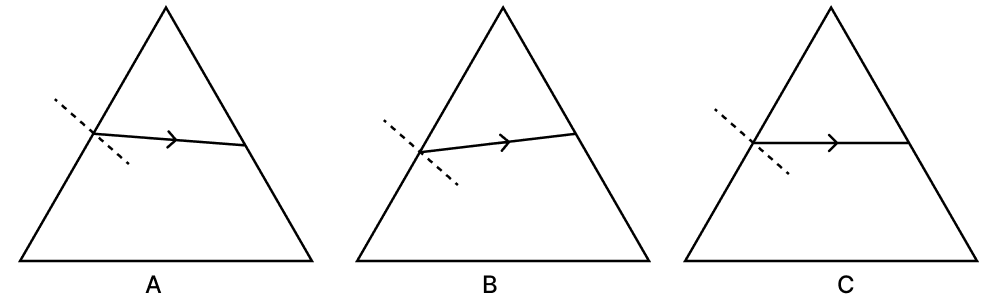
(a) the angle of incidence is maximum.
(b) the angle of incidence is minimum.
(c) the angle of incidence is equal to the angle of emergence.