
Biology
Given below is a set of six experimental set-ups (A-F), kept in this state for about 24 hours.
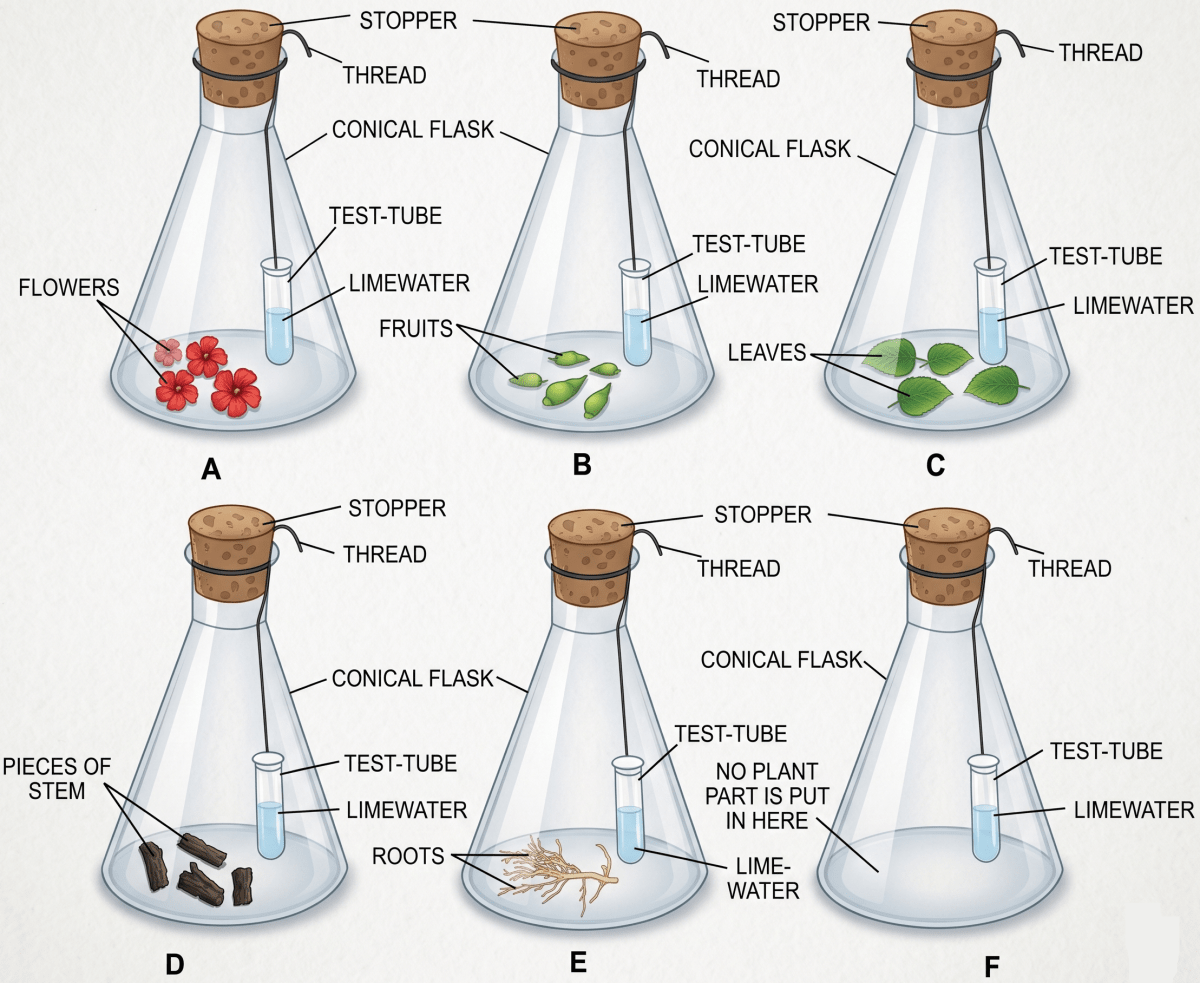
(a) In how many flasks, the different plant parts have been kept under observation?
(b) What is the purpose of keeping a test-tube containing limewater in each flask?
(c) In which tube/tubes the limewater will turn milky?
(d) What is the purpose of the set-up F?
(e) What conclusion can you draw from this experiment?
Plants Respiration
187 Likes
Answer
(a) The different plant parts for observation have been placed in five flasks right from A-E flasks as observed in the diagram.
(b) It is the property of limewater to absorb Carbon dioxide. Hence it is placed in the flask, so as to absorb Carbon dioxide and turn milky in the presence of any Carbon dioxide.
(c) Limewater turns milky in the presence of Carbon dioxide. All five flasks from A to E have plant parts hence respiration takes place in all five parts causing the limewater to turn milky. In flask F, respiration does not take place as there is no plant part, hence no change is observed
(d) In the experiment, the setup F depicts the experiment control, wherein all conditions are maintained in the same way except for the plant part that is absent in flask F.
(e) The experiment clearly shows that Carbon dioxide is produced during the process of respiration.
Answered By
120 Likes
Related Questions
In order to study and prove a particular physiological process in plants, the following experiment was set up. Study the same and then answer the questions that follow:
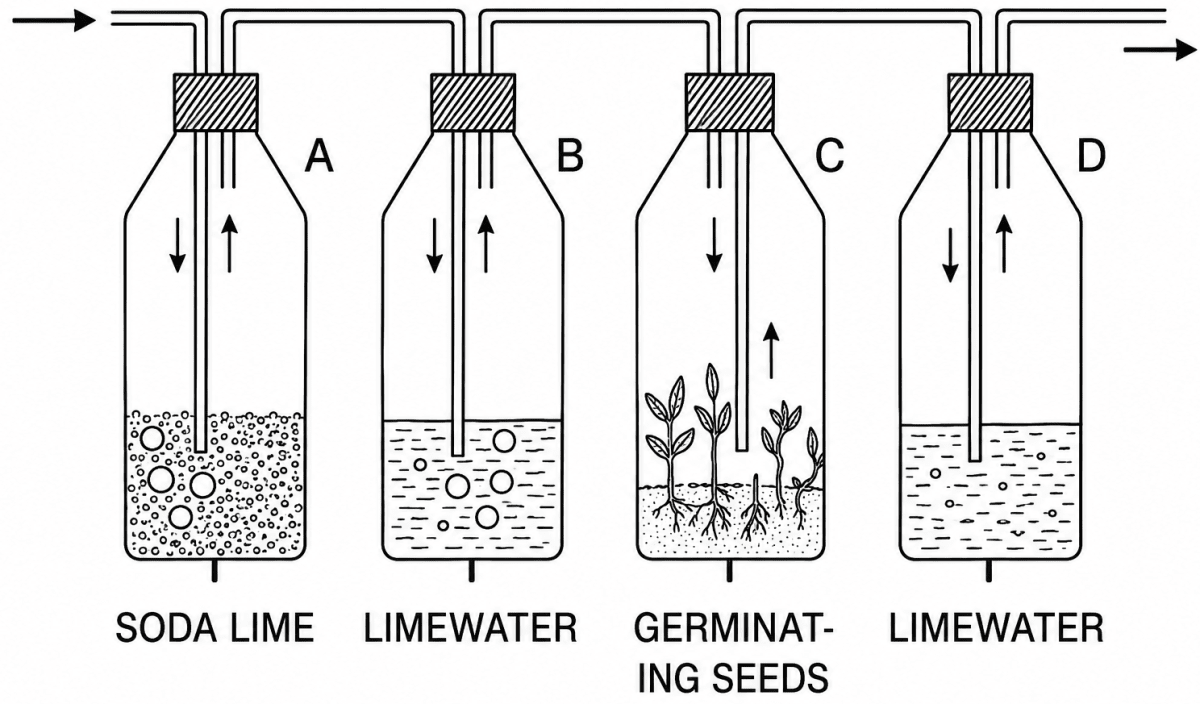
(a) Name the physiological process being studied.
(b) What is the function of soda lime in the bottle 'A' and why is limewater placed in bottle 'B'?
(c) What change would you expect to observe in bottle 'D'?
(d) Represent the physiological process named in (a) above in the form of a chemical equation.
(e) In order to obtain accurate results, the bottle ‘C’ should be covered with a piece of black cloth. Why?
(f) If bottle 'C' was fitted with a 3-holed rubber stopper and a thermometer were introduced in such a way that its bulb reaches close to the germinating seeds, what would you observe? Why?
The following diagram refers to an apparatus which is used to demonstrate a physiological process:
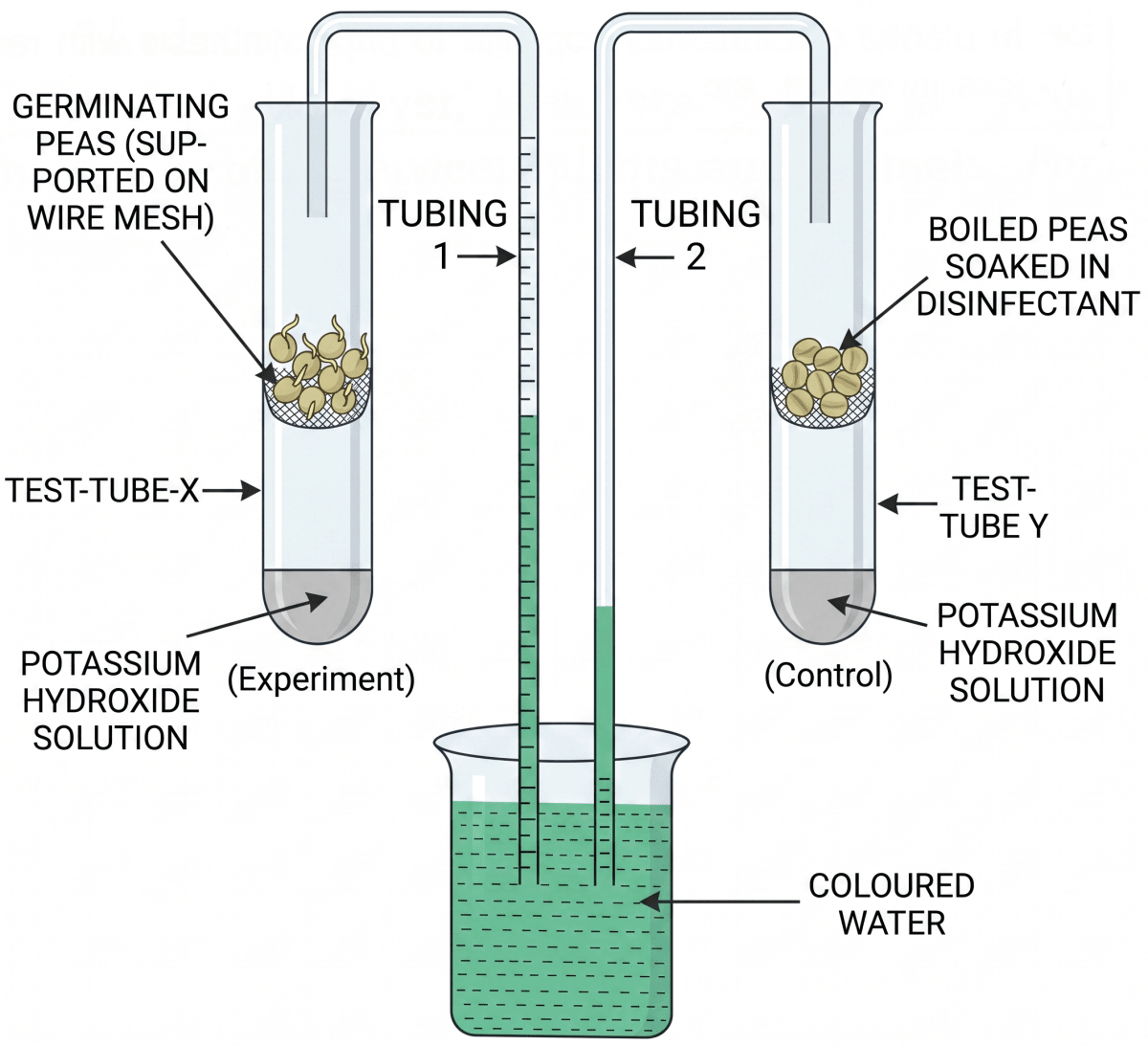
(a) What is the purpose of keeping potassium hydroxide solution in the test tubes X and Y?
(b) Why has the coloured water risen in tubing 1?
(c) What is the purpose of keeping boiled peas soaked in a disinfectant in test tube Y?
(d) Name the biological process which causes the above rise.
(e) Define the biological process shown in the experiment
Assertion (A): All the parts of a plant respire all the time, whether it is day or night.
Reason (R): Among all the parts of a plant, only the leaves respire because they contain stomata which help in the diffusion of respiratory gases.
- Both A and R are true and R is the correct explanation of A.
- Both A and R are true but R is not the correct explanation of A.
- A is true but R is false.
- A is false but R is true.
Assertion (A): Respiration is a catabolic process which produces energy in the form of ATP.
Reason (R): Respiration is the process in which glucose is broken down in a series of chemical steps to produce energy.
- Both A and R are true and R is the correct explanation of A.
- Both A and R are true but R is not the correct explanation of A.
- A is true but R is false.
- A is false but R is true.